









Technical Interviews
Business Intelligence Analyst Interview Questions With Examples
Practice BI questions about metric definitions, table grain, duplicate joins, dashboard decisions, and reconciling conflicting reports.
Interview Pilot Editorial Team
3 min read

Show that you can turn business questions into reliable, understandable reporting. A dashboard is not trustworthy simply because it refreshes successfully or looks polished.
These original practice questions emphasize metric definitions, data modeling, and decisions. They supplement, rather than reproduce, the broader data analyst interview guide.
1. Two teams report different revenue. How do you investigate?
Ask each team to define the measure before comparing totals. Check the time period, timezone, recognized versus booked activity, refunds, test records, and inclusion rules. Then compare the underlying data and transformations.
An illustrative answer:
I would take a small set of transactions and trace them through both reports. If one report excludes refunded orders and the other includes them, that may be a definition difference rather than a broken query. I would document the intended use and obtain agreement on the appropriate measure before changing either report.
Do not select the higher number because it is more favorable or silently overwrite an established definition.
2. What does the grain of a table mean?
The grain describes what one row represents. Microsoft's star-schema guidance explains the importance of consistent grain in fact tables and distinguishes facts from dimensions.
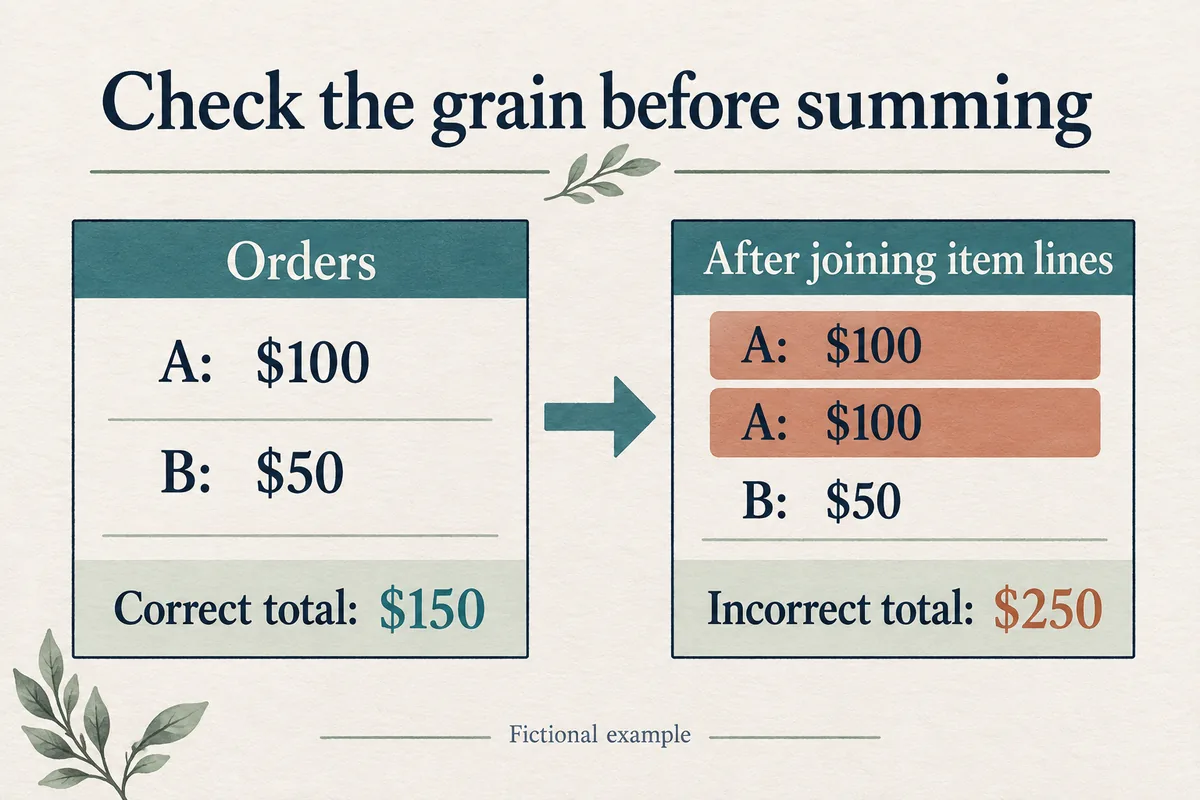
Make the answer concrete. An orders table might contain one row per order, while an order-lines table contains one row per item line. Summing a field after joining those tables can repeat an order-level amount.
Fictional example:
| Order | Order total | Number of item lines |
|---|---|---|
| A | $100 | 2 |
| B | $50 | 1 |
The order total is $150. If the join repeats A's $100 on two rows and you sum that repeated field, you get $250. The remedy depends on the question: aggregate at the intended grain or use the appropriate line-level measure. Do not use a distinct sum of amounts as a general fix; different orders can legitimately have the same value.
3. A stakeholder asks for a dashboard. What do you ask first?
Ask who will use it, what decision they will make, how often, and what action follows a change in a metric. Clarify the level of detail, freshness needs, and access restrictions.
For a support manager, an actionable view might prioritize aged unresolved cases and ownership. A decorative display of total historical tickets may not answer today's staffing question.
Explain how you would review a small prototype with the user before building every requested chart. Separate a useful initial scope from ideas that can wait.
4. A conversion rate changes after filtering. Is the report wrong?
Not necessarily. Check how the numerator and denominator respond to the filter. Define whether the rate describes the filtered population or compares it with a broader total.
Use a small hand-checkable dataset to verify the calculation. Avoid averaging subgroup percentages when the intended measure is total conversions divided by total eligible observations; unequal group sizes can change the result.
5. How do you release a reporting change?
Explain validation against known cases, comparison with the prior report, stakeholder review, and documentation of intentional differences. Confirm that permissions still apply and that refresh failures are visible.
For practice, take one metric and write its definition, grain, exclusions, owner, and verification example. Being able to explain those choices is more useful than memorizing a catalog of chart types.
Topics
Technical Interviews
business intelligence analyst interview questions
Continue reading

Technical Interviews
Cloud Engineer Interview Questions: Explain Recovery and Tradeoffs
Prepare cloud engineer interview answers about failure isolation, recovery testing, permissions, cost changes, and deployment safety without listing services blindly.
October 31, 2026
4 min read
Technical Interviews
Data Engineer Interview Questions With Pipeline Failure Scenarios
Practice data engineering questions about safe retries, late data, schema changes, quality checks, and backfills using explicit assumptions and validation.
October 31, 2026
3 min read

Technical Interviews
Backend Developer Interview Questions: Reliability and Trade-Offs
Practice backend interview reasoning for transactions, retried requests, authorization, slow endpoints, and background jobs with realistic failure scenarios.
September 29, 2026
3 min read