
















Interviews
Case Interview Practice: A Step-by-Step Framework
Learn how to run case interview practice sessions with a timed protocol, a self-review rubric, and drills that build structure and math skills.
Interview Pilot Editorial Team
Updated November 15, 2026
14 min read
The most popular case interview practice advice is to grind through as many cases as you can and memorize a short list of frameworks. That advice treats a finished case as progress. It is not. A case you never score is another lap around the same mistake, and a framework you recite before you know the client's goal solves the wrong problem with tidy labels.
Better practice treats every case as a logged feedback unit. You run it under a timer, say the reasoning out loud, and write down one correction before closing the notebook. Volume still matters, but only as a floor beneath a process you can repeat. The sections below set that volume, walk through one session, replace memorized labels with a consistent sequence, and show how to adapt the drills when the assessment is written, technical, or in a second language.
Practice Volume and Drill Mix to Plan
A practical benchmark cited by university career guidance, and summarized in the CaseTutor case-framework guide, is 30 to 50 total cases over a preparation cycle, including at least 25 live repetitions and more than 100 mental-math drills. The same synthesis found that deliberate practice explained about 4% of performance variance in education and less than 1% in professional domains, so hours alone are a weak predictor of who improves.
A session you can actually repeat
Build each live session the same way. Spend 5 minutes on a math warm-up, 20 to 30 minutes on the case itself, 10 minutes on structured feedback, and 5 minutes redoing the weakest moment. A full sitting lands around 40 to 50 minutes, which is short enough to protect on a weeknight and long enough to include a real close.
Pick a weekly target you can keep when work gets busy. Three live cases plus a daily 5-minute math set is a realistic floor for most candidates with a job or a full course load. Treat 30 to 50 as the minimum cycle, not a finish line you cross and then stop.
What the four drills train
Rotate four drills so you don't only get better at talking. Live cases train the conversation. Math drills train speed on the operations that show up inside those cases. Exhibit work trains the jump from a chart to a client implication. Recommendation drills train the close you will be graded on.
| Drill | Session length | Target volume | Skill built |
|---|---|---|---|
| Live interviewer-led case | 20-30 minutes | At least 25 live cases | Structuring, communication, problem solving |
| Mental-math drill | 5 minutes | More than 100 drills | Percentages, ratios, multiplication, division |
| Exhibit interpretation | 10 minutes | One exhibit inside each live case | Reading trends and stating implications |
| Recommendation practice | 30-60 seconds spoken | One at the end of each case | Answer first, two or three findings, one risk |
| Full cycle | 40-50 minutes per session | 30-50 total cases | Overall readiness across all four drills |
Practical rule: If you can't name the correction from the last case, you aren't ready for the next one.
Structure is what makes those reps comparable. In a meta-analysis of interview design, Wiesner and Cronshaw found that structured interviews produced a mean predictive-validity coefficient of 0.62, compared with 0.31 for unstructured interviews, about twice the predictive validity. A separate review of 114 entry-level interview-validity coefficients found that validity rose with structure, then hit a ceiling: past a moderate-to-high level, more structure added only about 0.01.
For you, that means a consistent process and standardized notes on logic, numerical accuracy, prioritization, and communication. Extra cases without those notes mostly rehearse whatever you already do. Confidence after an easy case is not the same thing as a scored improvement.
How to Run One Practice Session Step by Step
Process errors sink more candidates than missing industry facts. Hacking the Case Interview puts the failure modes on the sequence itself: skip the objective, force a memorized framework, calculate without a "so what," and you can be numerically right about the wrong decision. The same guidance notes that candidates often allocate less than 10% of their time to math even though mental-math errors are a frequently reported weakness.
The flow below is the whole sitting, from warm-up to the single correction you will chase next time.
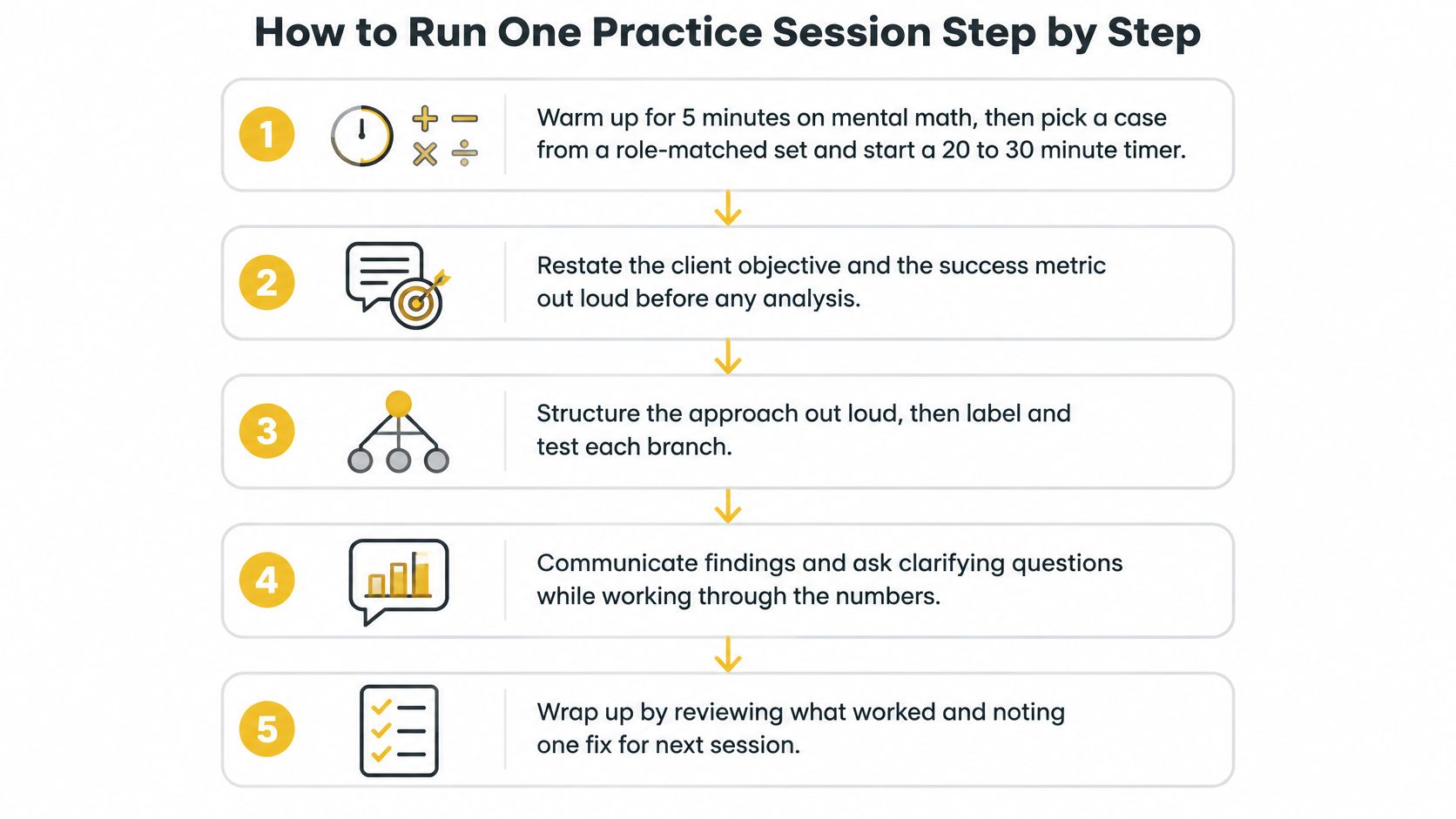
The six moves
Warm up for 5 minutes on percentages, ratios, multiplication, and division, then pick a case from a set that matches the role and start a 20 to 30 minute timer. The warm-up exists because cold math is where candidates lose the thread. The common slip is opening the notebook on an easy case you have already seen, which feels like fluency and teaches nothing.
Restate the client objective and the success metric out loud before any structure. Correct analysis of the wrong problem still fails, because the interviewer is scoring whether you solved their decision. The slip is jumping to buckets while the prompt is still fuzzy. If profit is the metric, revenue growth is not a substitute goal.
Build a bespoke issue tree around three or four priority areas, then state a hypothesis the data could prove wrong. A memorized framework feels safe and often hides the driver that matters. Mix market sizing, profitability, growth, pricing, M&A, operations, and public-sector prompts across the week so you don't overfit one pattern.
Work the numbers with an estimate, explicit units, an intermediate check, and a final sanity test. After each calculation, say the client implication in one sentence. Silent arithmetic hides unit mix-ups, and skipping the chart on the page leaves a whole skill untested. A clean number with no "so what" is an unfinished step.
Close with a 30 to 60 second recommendation: the answer first, two or three supporting findings, the principal risk, and one concrete next step. Interviewers remember the close more than the middle. The slip is walking back through your whole tree instead of deciding.
Spend 10 minutes on feedback, redo the weakest moment for 5 minutes, then log the objective, the structure, the calculations, the key insight, the recommendation, and one observable correction. Failing to log is how false confidence survives a bad case. If you want a partner before a human mock, a mock interview online is a useful bridge, as long as you still fill the log yourself.
A finished session is not a stack of notes. It is one logged correction and a clearer picture of the moment to redo next time. Watch a timed run to see how short the close really is.
How to Structure a Case Without a Memorized Framework
Reciting "profitability" or "market entry" at the start of a case is a reflex, not a structure. Labels don't predict who does well in an interview. Consistency does. A 1993 synthesis of employment-interview studies reported validity from 0.20 for low-structure interviews to 0.57 at the highest structured level, a net increase of 0.37. The same literature put operational validity at 0.44 for structured interviews across 106 studies and 12,847 participants, versus 0.33 for unstructured interviews across 39 studies and 9,330 participants. None of that is a consulting pass rate. It is a reason to use the same sequence every time, then bend it to the prompt.

The sequence, then a case
Use this order, out loud:
- Clarify the objective. Name the decision and the metric before you draw anything.
- Split into mutually exclusive areas. No overlap, and no branch you can't test with the data you expect.
- State a hypothesis. One claim the next number could kill.
- Calculate. Units on every line, then a sanity check.
- Synthesize. What the number means for the client, not what the formula was.
- Recommend. Answer, support, risk, next step.
Say a retail chain's profit fell 8% year over year. You clarify that profit, not revenue, is the metric. You split the problem into revenue and cost. Your hypothesis is that volume held while unit margin fell after a promotion. A quick calculation tests that claim before you open a deeper branch. If volume dropped, you drop the promotion story and follow the volume branch instead.
Which branches stay open
Revenue splits into price and volume. Cost splits into labor, materials, and overhead. You keep a branch open only when the exhibit or the interviewer's answer can test it. A pretty tree that no number can touch is decoration.
Drop any branch that doesn't fit the case in front of you, even if it lived in last week's framework.
The same habit shows up in written problem-solving scenarios: start from the decision, not from a template you liked. Rigid structure feels professional and still misses the driver. Consistent structure is the sequence above, applied loosely enough that a bad hypothesis gets retired in the next sentence.
Tracking Errors with a Self-Review Rubric
Most practice advice tells you to do dozens of cases, think aloud, and drill math. It rarely tells you how to diagnose why a case went badly. Carnegie Mellon's 2025 preparation guide lists the dimensions interviewers actually watch: structuring, information sorting, quantitative analysis, recommendations, communication, and performance under pressure. High-volume repetition can lock in the same flawed habits unless you score those dimensions after every case. Candidates without a former consultant or a paid coach need that rubric more than another generic target.
What to write in the log
Separate errors into categories, then add two clocks. Time-to-insight is the minutes until the key insight appeared. Recovery after a mistake is the seconds you needed to resume the line of logic. Compare both across cases. A single slow case doesn't mean much. A slow trend does.
| Error category | What to check in the log | Sign of improvement |
|---|---|---|
| Problem framing | Was the objective and success metric restated before structuring? | Objective stated before the structure in most cases |
| Hypothesis quality | Did the hypothesis name a claim the data could prove wrong? | Hypotheses change when data contradicts them |
| Calculation accuracy | Were units, estimates and a sanity check used? | Fewer corrections to the final number |
| Prioritization | Was the largest driver explored first? | The first branch explored is the one that moves the answer |
| Communication | Was the answer given first, with clear signposting? | Recommendations start with the answer |
| Final recommendation | Did it include supporting findings, a risk and a next step? | All four parts present in every case |
| Time-to-insight | Minutes until the key insight appeared | Downward trend across repeated cases |
| Recovery after a mistake | Seconds needed to resume the line of logic | Shorter recovery across repeated cases |
The weekly review
Once a week, take the last five logs and count which category shows up most. That count is your next drill, not your mood after the last case.
- Framing keeps failing: Redo openings only. Objective and metric, then stop.
- Math keeps failing: Stay on the daily 5-minute set until the sanity check is automatic.
- The close keeps failing: Speak the 30 to 60 second recommendation from old notes, without redoing the whole case.
- Recovery is slow: Practice the sentence you will use when a number is wrong, then continue.
One category per week. Chasing all eight at once is how the log becomes a diary instead of a decision about what to practice next.
Adapting Practice to Your Format and Background
A spoken consulting case is not the only assessment. Interview Query's guide to data science case studies separates live cases, where you clarify goals, structure an approach, and communicate under pressure, from take-home cases, which also test data cleaning, visualization, scoping, and a written deliverable. Technical and data candidates may face SQL, Python, product metrics, or a dataset. Practicing only the classic spoken case leaves those tasks cold.

Parallel drills for the test you will actually sit
Match the drill to the employer's format, then add the constraint you personally face. Our consulting interview guide is a starting map for case types, not a script for every employer.
- Spoken reasoning: A timed live case with a partner or a recorder. You clarify, structure, and close out loud.
- Written synthesis: A one-page memo in 30 minutes. Same decision, no performance polish to hide behind.
- Timed technical analysis: A query, a metric definition, or a small dataset with a clock running.
- Clarification routine: Two questions before any structure, chosen because the answer would change your tree.
Fluency in the dominant style gets mistaken for reasoning. Carnegie Mellon's guide lists oral communication, presence, facility with numbers, pressure handling, and enthusiasm among evaluation areas. It doesn't explain how a candidate with an accent, a second language, a disability, or no coach shows the same analytical quality. Split the score. Record the answer and have a peer mark only the logic against your rubric. Accent, speed, and polish get a separate note, or they swallow the review.
If the format or an accommodation will change how you perform, ask the recruiter before the date is fixed. You want the practice calendar to mirror the actual sitting, not a generic case you found first.
Book Your First Timed Case This Week
Reading another framework list won't change Thursday's interview. A dated case will.
- Today, name the format and the role. Live or take-home, generalist or data, spoken or written. The next prompt has to come from that set, or the rep doesn't transfer.
- Put the first live case on the calendar within seven days. Block the 5-minute warm-up, the 20 to 30 minute timer, and the logged review in the same hold. If it isn't on the calendar, it isn't practice.
- Run the protocol and fill the rubric. Score logic, numbers, structure, and the recommendation. One correction, written where you will see it before the next case.
- Repeat at least three times in the first week. That is the weekly floor from the volume plan, not a heroic month. Same log, different prompt type.
- Checkpoint after ten logged cases. Compare error counts by category from the first log to the latest. The category that still appears most sets the next four weeks of drills.
If you want an outside read on delivery, our AI mock interviews evaluate your answers, and the Question Bank and Playground let you try a response before a full case. Use those scores next to your own rubric. They supplement the log. They don't replace your judgment about structure and logic.
A logged case teaches you more than an unlogged one.
Interview Pilot gives you AI mock interviews, a consulting question set, and a Question Bank so case interview practice stays timed and reviewable instead of vague. Use a mock to rehearse the opening, the math, and the 30 to 60 second close, then write the same correction you would after a human case. Start with a timed case on Interview Pilot this week and log the result before you book the next one.


Topics
case interview practice
consulting case interview
case interview prep
mental math drills
case interview framework
Continue reading
Interviews
8 Interview Tips for Finance Jobs: Prep Guide for 2026
Discover interview tips for finance jobs, from DCF and valuation questions to STAR stories, market awareness, mock practice, and smart follow-ups.
November 16, 2026
18 min read

Interviews
How to Use Your Phone as a Second Screen
Turn your phone into a second screen for a Windows PC or Mac: apps, cable options, Wi-Fi limits and how to set it up for a live online interview.
November 16, 2026

Interviews
Background Check Questions: What Candidates Should Prepare
Understand common employment background-check topics, verify your records, and respond accurately without volunteering unnecessary sensitive information.
November 16, 2026
2 min read