











Interviews
What to Say in a Video Interview: 20 Common Questions and Best Answers (2026)
Learn what to say in a video interview with 20 common questions, sample answers, and on-camera tips for Zoom and virtual interviews.
Interview Pilot Editorial Team
11 min read
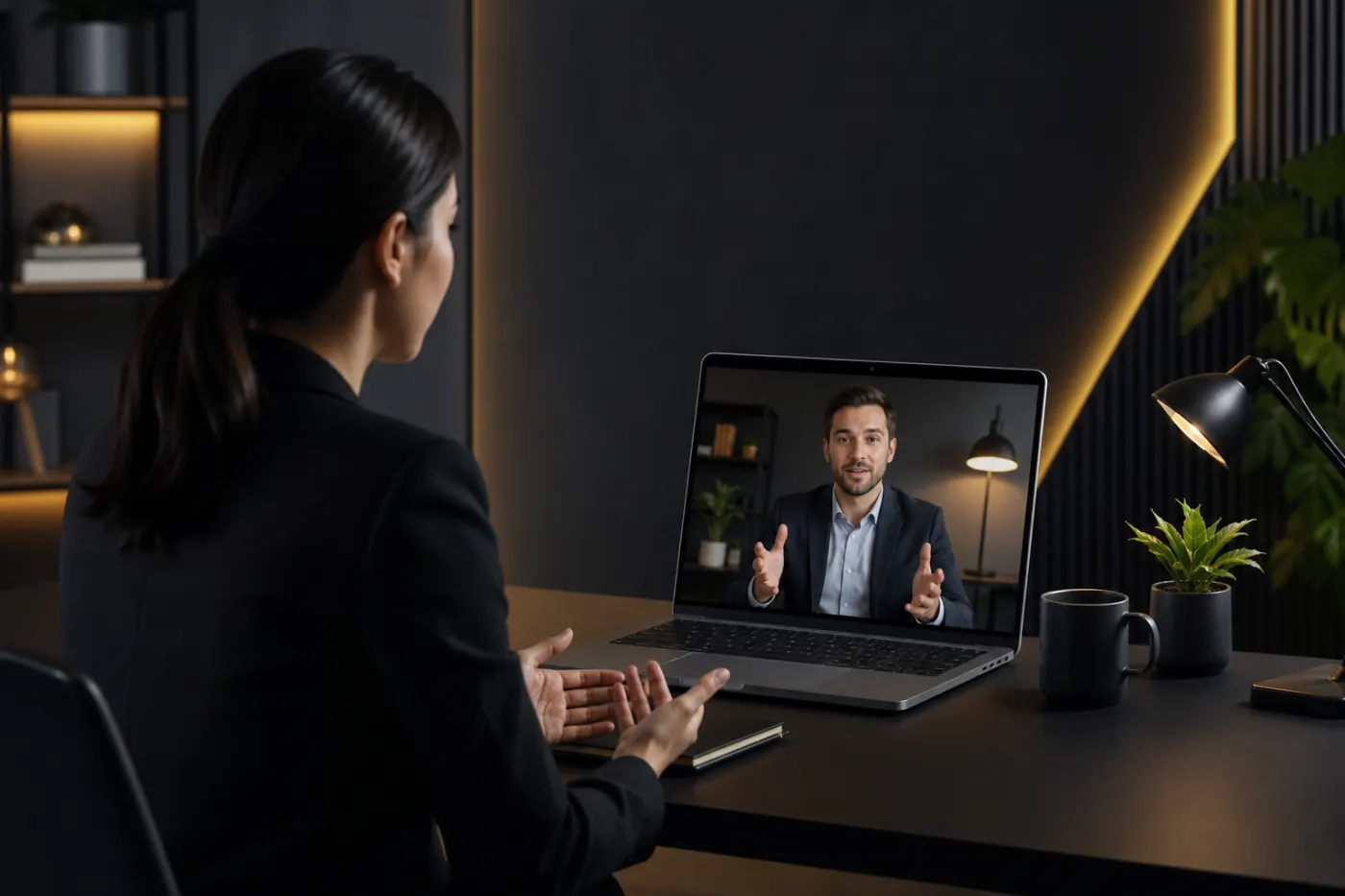
If you are preparing for a video interview, the goal is simple: sound clear, concise, and confident on camera. The best approach is to prepare short, structured answers you can deliver naturally, while also checking your setup so the interviewer focuses on your skills, not your tech.
This guide gives you practical video interview questions and answers, plus the on-camera delivery tips that make your answers land better in Zoom interviews and other virtual interviews.
Quick answer: how to do well in a video interview
Use this formula:
- Test your camera, mic, lighting, and internet before the interview.
- Keep your answers direct, usually 60 to 90 seconds unless the question needs more.
- Use a simple structure like past situation, action, and result.
- Look at the camera when making key points.
- Speak a little slower than normal and leave pauses.
- Have two or three examples ready for strengths, challenges, teamwork, and conflict.
If you do those things, you will already be ahead of many candidates who prepare only for the content and ignore the format.
What makes video interviews different from in-person interviews
The questions are often the same, but the delivery is not.
In a video interview, the interviewer is also noticing:
- whether you can communicate clearly without in-person energy
- how comfortable you are with remote collaboration
- whether you seem prepared and organized
- if your environment looks professional
- whether your answers stay focused on the main point
That means your answers should be a little tighter than in person. Long stories are harder to follow on a screen. The best virtual interview answers are specific, confident, and easy to listen to.
Before you answer any question: fix the basics
Good answers can still lose impact if the setup is bad. Use these video interview tips before you join the call:
- Put your camera at eye level.
- Face a light source, not a window behind you.
- Use headphones if your mic sounds echoey.
- Close extra tabs, apps, and notifications.
- Keep water nearby.
- Rename yourself professionally in the meeting room.
- Join 5 to 10 minutes early.
Also, check your background. It does not need to be perfect, but it should be clean and distraction-free. If your space is busy, use a simple virtual background only if it looks stable and natural.
How to structure strong video interview answers
 The easiest way to sound polished is to use a repeatable structure. Here are three that work well.
1. Present, past, future
Use this for “Tell me about yourself” or “Why do you want this role?”
- Present: what you do now
- Past: relevant experience that got you here
- Future: why this role makes sense next
2. STAR
Use this for behavioral questions.
- Situation
- Task
- Action
- Result
3. Claim, proof, impact
Use this for strengths questions.
- Claim: your skill or strength
- Proof: a specific example
- Impact: what changed because of it
20 common video interview questions and best answers
Below are common zoom interview questions with sample answers you can adapt.
1. Tell me about yourself
Best answer style: Present, past, future.
Sample answer:
I’m a customer success specialist with four years of experience helping SaaS clients adopt new tools and solve account issues quickly. In my current role, I manage a portfolio of enterprise accounts and work closely with sales and product teams to reduce churn and improve renewals. I’m now looking for a role where I can take on a larger strategic account load and keep building my work in a fully remote environment.
Why it works:
- It is job-related, not a life story.
- It shows current scope.
- It explains the move clearly.
2. Why do you want this role?
Sample answer:
This role fits the kind of work I do best: solving problems, building relationships, and working cross-functionally to improve the customer experience. I also like that your team emphasizes remote collaboration, because I’ve learned how to stay organized and proactive in distributed environments. I’m excited about the chance to contribute from day one while continuing to grow.
Why it works:
- It connects your strengths to the job.
- It shows research without sounding scripted.
3. Why are you leaving your current job?
Sample answer:
I’ve learned a lot in my current role, especially about handling complex client needs and working independently. I’m now looking for a position with more room to grow in scope and responsibility. This opportunity feels like a strong next step because it matches my experience and gives me a chance to contribute at a higher level.
Why it works:
- It stays positive.
- It avoids criticizing your current employer.
4. What are your strengths?
Sample answer:
One of my strengths is turning unclear problems into a simple action plan. For example, when a process change caused delays in our onboarding workflow, I mapped the issue, aligned the right stakeholders, and helped reduce back-and-forth by documenting a clearer process. I’m also reliable in remote settings because I communicate early and keep updates organized.
Why it works:
- It names the strength.
- It gives proof.
- It connects to remote work.
5. What is your biggest weakness?
Sample answer:
Early in my career, I sometimes spent too long polishing work before sharing it. I’ve improved by setting clearer time limits and asking for feedback earlier in the process. That has helped me move faster without lowering quality.
Why it works:
- It is honest without being damaging.
- It shows growth.
6. Why should we hire you?
Sample answer:
You should hire me because I bring the mix of experience, communication, and follow-through this role needs. I’m comfortable working independently, I document my work well, and I know how to stay responsive in a virtual team. I can help solve problems quickly while keeping projects moving.
Why it works:
- It gives a practical reason.
- It highlights remote-ready habits.
7. Tell me about a time you handled a difficult situation
Sample answer:
In one project, a key stakeholder changed requirements late in the process, which put the timeline at risk. I set up a quick call, clarified the new priorities, and separated the work into must-have and nice-to-have items. That let us ship the core deliverable on time while scheduling the remaining changes for a later phase.
Why it works:
- It uses STAR.
- It shows calm problem-solving.
8. Tell me about a time you worked on a team
Sample answer:
On a launch project, I worked with marketing, operations, and support to make sure we had consistent customer messaging. I owned the support side, kept everyone updated in writing, and flagged issues before launch. The result was a smoother rollout and fewer last-minute corrections.
Why it works:
- It shows collaboration.
- It includes your role clearly.
9. How do you handle conflict?
Sample answer:
I try to separate the person from the issue. If there is disagreement, I focus on the shared goal, ask clarifying questions, and look for the facts behind each view. In most cases, that turns the conversation from personal friction into a problem-solving discussion.
Why it works:
- It sounds mature.
- It shows emotional control.
10. Describe a time you made a mistake
Sample answer:
I once sent a client update before confirming one detail with the internal team, and I had to correct it quickly. Since then, I use a final verification step for anything client-facing. That change has helped me avoid repeat errors and improve trust.
Why it works:
- It takes responsibility.
- It shows a process improvement.
11. What accomplishment are you most proud of?
Sample answer:
I’m proud of a workflow improvement I led that reduced repeated manual work for my team. I documented the issue, tested a simpler process, and trained the team on the new steps. It saved time and made the process easier for new hires to follow.
Why it works:
- It is measurable in effect, even if not numeric.
- It shows initiative.
12. How do you stay organized when working remotely?
Sample answer:
I use a daily priorities list, block time for deep work, and keep updates in writing so nothing gets lost. I also check in early if I see a risk to a deadline. In a remote setting, I think clear communication matters as much as the work itself.
Why it works:
- It directly addresses virtual work.
- It reassures the interviewer.
13. How do you manage multiple deadlines?
Sample answer:
I start by identifying what is urgent versus what is truly important. Then I break larger tasks into milestones and communicate early if priorities need to shift. That helps me avoid last-minute surprises and keep expectations realistic.
Why it works:
- It shows prioritization.
- It shows communication.
14. Tell me about a time you had to learn something quickly
Sample answer:
I joined a project that used a tool I had not used before, so I spent the first few days learning the workflow, reviewing internal notes, and asking targeted questions. Within a short time, I was able to contribute without slowing the team down.
Why it works:
- It shows adaptability.
- It is believable and concise.
15. What are your salary expectations?
Sample answer:
I’m open to a range that matches the scope of the role and the overall package. Based on my experience and the responsibilities we’ve discussed, I’d expect something competitive for the market and would be happy to learn more about your budgeted range.
Why it works:
- It stays flexible.
- It keeps the conversation moving.
16. Why did you apply for this company?
Sample answer:
I applied because the role aligns with the type of work I’ve done well, and the company seems to value clear communication and strong execution. I’m especially interested in environments where teams work well across functions and where remote collaboration is taken seriously.
Why it works:
- It sounds thoughtful.
- It connects to the company and role.
17. What do you know about our company?
Sample answer:
I understand that your team focuses on helping customers get value quickly and that the role requires strong communication across internal teams. What stood out to me is the emphasis on dependable execution and a remote-friendly workflow, which matches how I like to work.
Why it works:
- It shows preparation.
- It avoids reciting a website summary.
18. How do you handle feedback?
Sample answer:
I like feedback when it is specific and actionable. If someone points out a gap, I try to understand the standard they want, make the adjustment, and apply it going forward. I see feedback as part of getting better, not as a criticism of the person.
Why it works:
- It shows coachability.
- It signals professional maturity.
19. Where do you see yourself in five years?
Sample answer:
In five years, I want to be in a role where I’ve built deeper expertise, taken on more responsibility, and become someone the team trusts with complex work. I’m less focused on a title and more focused on growing in impact and skill.
Why it works:
- It is ambitious without sounding unrealistic.
- It fits many roles.
20. Do you have any questions for us?
Sample answer questions:
- What does success look like in the first 90 days?
- What are the biggest priorities for this role right now?
- How does the team communicate and collaborate in a remote setting?
- What do strong performers on this team do differently?
Why it works:
- It shows interest.
- It helps you evaluate the role.
Video interview tips that improve every answer
Even great answers can sound weak if the delivery is rushed or flat. Use these habits during the call.
Look at the camera for your main point
When you answer, it is fine to glance at the interviewer’s image or your notes briefly. But when you deliver the main point, look into the camera. That creates better eye contact on screen.
Pause before answering
A one-second pause makes you sound more thoughtful and less reactive. It also gives you time to organize your answer.
Keep your face animated
Video flattens expression. Use a little more facial energy than you would in person, but stay natural.
Avoid overexplaining
If you tend to ramble, use a rule: answer the question, give one example, and stop. If the interviewer wants more, they will ask.
Use notes the right way
A few bullet points are helpful. A full script usually sounds stiff. Keep notes short:
- key strengths
- two examples
- company name
- questions to ask
A simple prep plan for the day before
If your interview is soon, use this checklist.
| Time | What to do |
|---|---|
| 24 hours before | Review the job description and prepare 6 to 8 stories |
| 2 hours before | Test camera, mic, and internet |
| 30 minutes before | Close distractions and review your notes |
| 10 minutes before | Join early, breathe, and get settled |
| During the interview | Speak slowly, pause, and stay on topic |
Common mistakes to avoid in virtual interviews
| Mistake | Better approach |
|---|---|
| Reading answers word for word | Use short notes and speak naturally |
| Looking at your own image too much | Look at the camera for key points |
| Giving long, unfocused stories | Use a simple structure and keep it tight |
| Poor lighting or background noise | Set up your space before the call |
| Talking too fast | Slow down and pause between ideas |
| Forgetting to ask questions | Prepare 3 to 4 questions in advance |
How to tailor your answers for Zoom interviews
For zoom interview questions and other virtual interviews, add a few details that show you can work well remotely.
Use phrases like:
- “I keep updates in writing so everyone stays aligned.”
- “I’m comfortable working independently and checking in proactively.”
- “I use clear documentation to reduce follow-up confusion.”
- “I stay responsive across time zones and shared work tools.”
These phrases help your answers sound relevant to remote hiring without forcing the topic.
Final take: what to say in a video interview
The best thing to say in a video interview is not a perfect script. It is a clear, direct answer that shows you understand the role, can communicate well on camera, and know how to work professionally in a virtual setting.
If you prepare your stories, keep your answers concise, and handle the technical basics, you will sound more confident right away.
For more help, review the question bank, practice with interview guides, or use Interview Copilot to sharpen your answers before the call.
Topics
interviews
candidate-playbook
zoom interview questions
video interview tips
virtual interview answers
Continue reading

Interviews
25 Virtual Interview Tips to Look Professional on Camera in 2026
Use these virtual interview tips to improve your camera setup, lighting, audio, body language, and confidence before your next video interview.
July 22, 2026
11 min read
Interviews
How to Prepare for a Video Interview: Checklist and Tips
Use this video interview checklist to set up your camera, lighting, audio, and test run so you can start calm and look prepared.
July 5, 2026
8 min read

Interviews
What to Say When You Don't Know the Answer in a Technical Interview
Use this exact framework, sample scripts, and examples to answer technical interview questions when you do not know the answer.
August 23, 2026
10 min read