












Interviews
How to Prepare for a Phone Interview: Checklist and Answers (2026)
Use this phone interview prep checklist to get organized, answer common questions clearly, and make a strong first-round impression.
Interview Pilot Editorial Team
9 min read

If you are asking how to prepare for a phone interview, focus on three things: know your story, control your environment, and answer with structure. A phone screen is usually a quick screening call, so the goal is not to impress with volume. It is to sound clear, prepared, and easy to move forward.
This guide gives you a practical phone interview checklist, the most common phone interview questions and answers, and the phone screen tips that matter most when the interviewer cannot see your body language.
Quick answer: what to do before a phone screen
Before the call, make sure you can do these seven things:
- Confirm the time, timezone, interviewer name, and phone number.
- Review the job description and highlight 3 to 5 matching skills.
- Prepare a 30-second introduction and a 60-second career summary.
- Pick 3 work examples that show results, teamwork, and problem-solving.
- Quiet your environment and use a reliable headset or phone connection.
- Keep a one-page cheat sheet with notes, questions, and numbers.
- Practice speaking slowly and pausing so you do not rush.
A strong phone screen is less about charisma and more about clarity.
Why phone interviews are different
A phone interview is often the first filter in the hiring process. Recruiters and hiring managers use it to check basic fit, communication, compensation expectations, availability, and motivation. Since they cannot read facial expressions or see your confidence cues, your words and pacing matter more than in a video or in-person interview.
That means your prep should be practical. Do not overprepare by memorizing scripts. Instead, prepare short, usable answers that sound like you.
Phone interview prep checklist
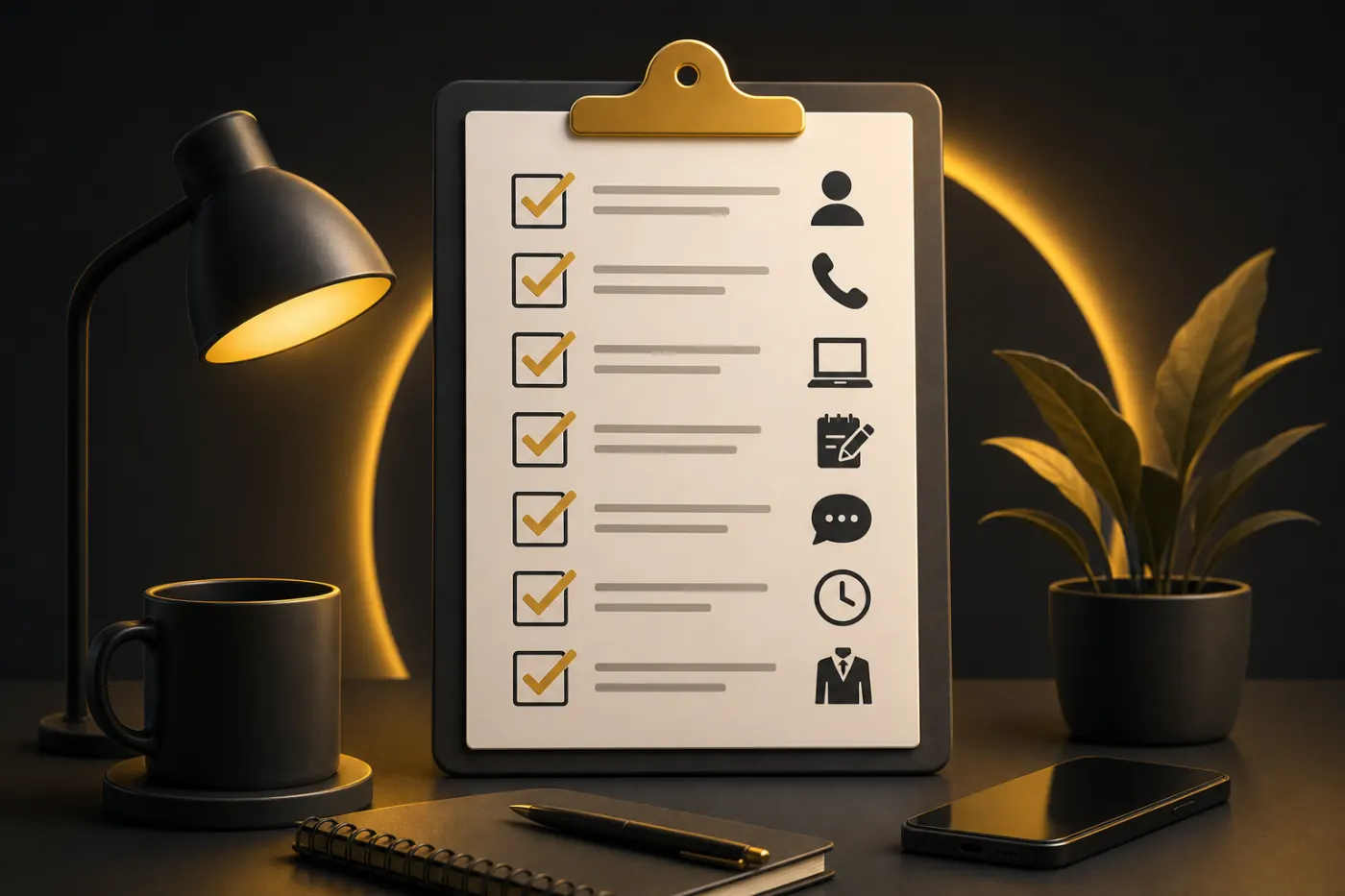 Use this checklist the day before and again 30 minutes before your call.
| Area | What to do | Why it matters |
|---|---|---|
| Job fit | Re-read the posting and match your experience to the top requirements | Helps you answer "Why are you a fit?" quickly |
| Company research | Review the company website, recent updates, product lines, and values | Shows interest and reduces vague answers |
| Resume review | Know every line of your resume and be ready to explain gaps or switches | Recruiters often ask about timeline and decisions |
| STAR stories | Prepare 3 examples using Situation, Task, Action, Result | Makes answers sharper and easier to follow |
| Salary range | Decide your target and backup range before the call | Prevents awkward hesitation |
| Logistics | Charge your phone, silence notifications, and test reception | Avoids technical distractions |
| Notes | Keep a one-page summary in front of you | Keeps you on track without sounding rehearsed |
| Questions | Prepare 4 to 6 smart questions | Shows genuine interest and helps you assess the role |
If you want more general interview structure support, you can also review Interview Pilot's interview guides.
Set up the right environment
Your surroundings shape how you sound. A good phone screen setup should reduce interruptions and keep your voice steady.
Do this before the call
- Take the interview in a quiet room with the door closed.
- Use headphones or a headset if possible.
- Turn off notifications, smart speakers, and other alerts.
- Keep water nearby.
- Stand or sit in a posture that lets you speak clearly.
- Avoid walking around unless you know your signal is stable.
If you must take the call in a less-than-perfect place
Use a short opener to manage expectations:
"Thanks for calling. I'm in a quiet spot, but if the connection drops, I'll call right back."
That is better than pretending everything is perfect when it is not.
Build your one-page cheat sheet
One of the best phone screen tips is to keep a single page of notes in front of you. Do not create a full script. Create a map.
Include these sections:
- Your 30-second introduction
- The role title and company name
- 3 matching strengths
- 3 work stories with results
- Compensation notes
- Questions to ask
- Interviewer name and pronunciation
Here is a simple format:
Intro: I’m a customer success analyst with 4 years of experience improving onboarding and retention.
Fit: reporting, client communication, process improvement
Story 1: reduced onboarding time by 20%
Story 2: handled escalations and improved renewal rates
Story 3: created a dashboard that saved weekly manual work
Questions: team goals, success metrics, next steps
Salary: target $X-$Y
This keeps you grounded without making you sound scripted.
What to say in the first 60 seconds
The opening matters because it sets the tone. Be polite, calm, and concise.
A strong opening sounds like this:
"Hi, thanks for taking the time to speak with me today. I’m glad to learn more about the role and share how my background fits what you’re looking for."
If the interviewer starts with small talk, keep it light and brief. Then move naturally into your background summary.
Best answers to common phone interview questions
Below are the most common phone interview questions and answers you should prepare for. Keep your answers short enough to stay focused, but detailed enough to show substance.
1. Tell me about yourself
What they want: a quick professional summary tied to the role.
Sample answer:
"I’m a marketing coordinator with three years of experience in campaign planning, email execution, and performance reporting. In my last role, I helped improve lead quality by working closely with sales on messaging and follow-up. I’m now looking for a role where I can take on more ownership across campaign strategy and analytics, which is why this position stood out."
Why it works: it gives title, experience, impact, and direction in under a minute.
2. Why are you interested in this role?
What they want: proof you understand the role and are not applying randomly.
Sample answer:
"This role matches the kind of work I enjoy most: solving problems, working cross-functionally, and improving processes. I also noticed the team seems to value ownership and communication, which are strengths I’ve built in my current role."
Why it works: it connects your preferences to the job requirements.
3. Why are you leaving your current job?
What they want: professionalism and no negativity.
Sample answer:
"I’ve learned a lot in my current role, especially about stakeholder management and execution. I’m looking for a position with more room to grow in [specific area], and this opportunity feels like a better fit for that next step."
Why it works: it stays positive and forward-looking.
4. What relevant experience do you have?
What they want: direct fit for the job.
Sample answer:
"In my last role, I handled [core responsibility]. I also worked on [second responsibility], where I had to coordinate with [team or department]. One example is when I [result], which helped the team [business outcome]."
Why it works: it gives evidence instead of just claims.
5. What are your salary expectations?
What they want: whether your expectations are in range.
Sample answer:
"Based on my experience and the scope of the role, I’m targeting a range around $X to $Y. I’m flexible depending on the full compensation package and the responsibilities of the position."
Why it works: it gives a range, not a demand, and keeps the conversation open.
6. When could you start?
What they want: availability and planning.
Sample answer:
"I’d want to give my current employer appropriate notice, so I’d likely be available about two weeks after accepting an offer. If there’s a different timeline you need, I’d be happy to discuss it."
Why it works: it is honest and professional.
7. Do you have any questions for me?
What they want: engagement.
Sample answer questions:
- What does success look like in the first 90 days?
- What challenges is the team trying to solve right now?
- What qualities do top performers on this team share?
- What are the next steps in the process?
If you need more practice with likely questions, browse the interview questions page or the question bank.
How to answer without rambling
The biggest mistake in a phone screen interview is overexplaining. Because the interviewer cannot see your expressions, a long answer can sound uncertain even if your experience is strong.
Use this simple structure:
- State the answer first.
- Add one brief example.
- End with the result or takeaway.
Example:
"Yes, I’ve worked with that tool. In my last role, I used it weekly to track project updates and flag risks. That helped our team reduce missed deadlines and keep stakeholders informed."
This keeps your answer tight and easy to follow.
Phone screen tips that make a real difference
These are small details, but they often separate a pass from a polite no.
- Smile while you speak. It changes your tone.
- Pause before answering difficult questions.
- Ask for clarification if needed.
- Use names when appropriate.
- Keep your answers oriented to results.
- Write down important details during the call.
- Treat the conversation like a professional discussion, not a casual chat.
Also, avoid common traps like interrupting, speaking too softly, or sounding rushed because you are trying to "sound smart."
Common mistakes to avoid
| Mistake | Better approach |
|---|---|
| Sounding unprepared | Keep notes and review the role beforehand |
| Giving long, unfocused answers | Use a short structure with example and result |
| Talking negatively about past employers | Stay professional and forward-looking |
| Not knowing your resume | Review your timeline and accomplishments in advance |
| Forgetting to ask questions | Prepare thoughtful questions before the call |
| Ignoring salary planning | Decide your range before the interview |
| Using a noisy space | Pick a quiet, stable environment |
A simple 24-hour phone interview prep plan
If your call is tomorrow, use this sequence.
The day before
- Review the job description.
- Write your 30-second intro.
- Choose 3 STAR stories.
- Prepare salary and availability notes.
- Write 4 questions to ask.
- Test your phone and charger.
One hour before
- Re-read your notes.
- Find a quiet room.
- Silence notifications.
- Drink water.
- Take a short walk to calm down.
Five minutes before
- Open your cheat sheet.
- Breathe slowly.
- Stand or sit comfortably.
- Answer the call with a clear greeting.
What to do after the phone interview
Follow-up matters. A short thank-you message reinforces your interest and professionalism.
A good follow-up email can be simple:
Subject: Thank you for your time
Hi [Name],
Thank you for speaking with me today. I enjoyed learning more about the role and the team. I’m especially interested in the opportunity because of [specific point]. Please let me know if I can share anything else as you move forward.
Best, [Your Name]
If the interviewer gave next-step timing, mention that in your notes and follow up only if the timeline passes.
Final checklist before you dial in
Use this final pass before the call starts:
- I know the interviewer’s name.
- I can explain my background in 30 seconds.
- I have 3 examples ready.
- I know my salary range.
- I have 4 questions prepared.
- My phone is charged and stable.
- My environment is quiet.
- I am ready to speak slowly and clearly.
Next step
If you want to keep preparing, review our interview guides, practice with common interview questions, or build stronger answers in the question bank.
Topics
interviews
candidate-playbook
phone interview questions and answers
phone screen tips
phone screen interview
Continue reading

Interviews
What to Say in a Phone Interview: 25 Common Questions and Best Answers
A practical guide to phone interview questions and answers, with concise scripts, pacing tips, and examples for recruiter screens and hiring manager calls.
June 24, 2026
12 min read

Interviews
8 Common Phone Screen Interview Questions and Best Answers (2026)
Prepare for common phone screen interview questions with short, effective answers for recruiter screens, logistics, motivation, and fit questions.
June 29, 2026
10 min read

Interviews
What to Say When You Don't Know the Answer in a Technical Interview
Use this exact framework, sample scripts, and examples to answer technical interview questions when you do not know the answer.
August 23, 2026
10 min read