












Interviews
Target Recorded Interview: Your Complete 2026 Guide
Master the Target recorded interview process with this comprehensive guide. Learn how it works, what to expect, and proven tips for success in 2026.
Interview Pilot Editorial Team
Updated October 11, 2026
16 min read

Target's recorded interview takes approximately 30 minutes, and you can re-record your answers before submitting the final versions. That flexibility sets it apart from a live video interview, where a stumble happens in real time and can't be replaced.
You've opened an email from “Target Careers,” found a camera-and-microphone check, and now you're staring at a practice question on your screen. It's normal to wonder whether a recruiter is watching, how long you have to answer, and what happens if your first attempt sounds awkward.
A Target recorded interview is an asynchronous assessment. You receive prerecorded questions, record your response to each one, and submit the completed interview for later review. There's no recruiter waiting for an immediate reply, but the recording still needs to show clear judgment, communication, teamwork, and role-specific evidence.
What Is the Target Recorded Interview
A candidate named Maya might receive the invitation after applying for a store role. She clicks the link expecting a live video call, only to find a setup screen, a practice question, and prerecorded prompts. Her first reaction is relief because nobody is watching in real time. Her second is uncertainty because she now has to communicate warmth and competence to a camera without a live person creating natural conversation.
That distinction matters. In a live interview, the interviewer can ask you to clarify a detail, respond to your energy, or help you recover after an awkward answer. In Target's recorded process, the prompt is fixed, your response is captured, and a recruiter or hiring manager reviews the submitted video later with your résumé and application. Target says recorded interviews are used only for some business areas, alongside phone, virtual, and in-person formats, so the process depends on the role and location. Target's recorded interview guidance explains the format directly.
What happens on screen
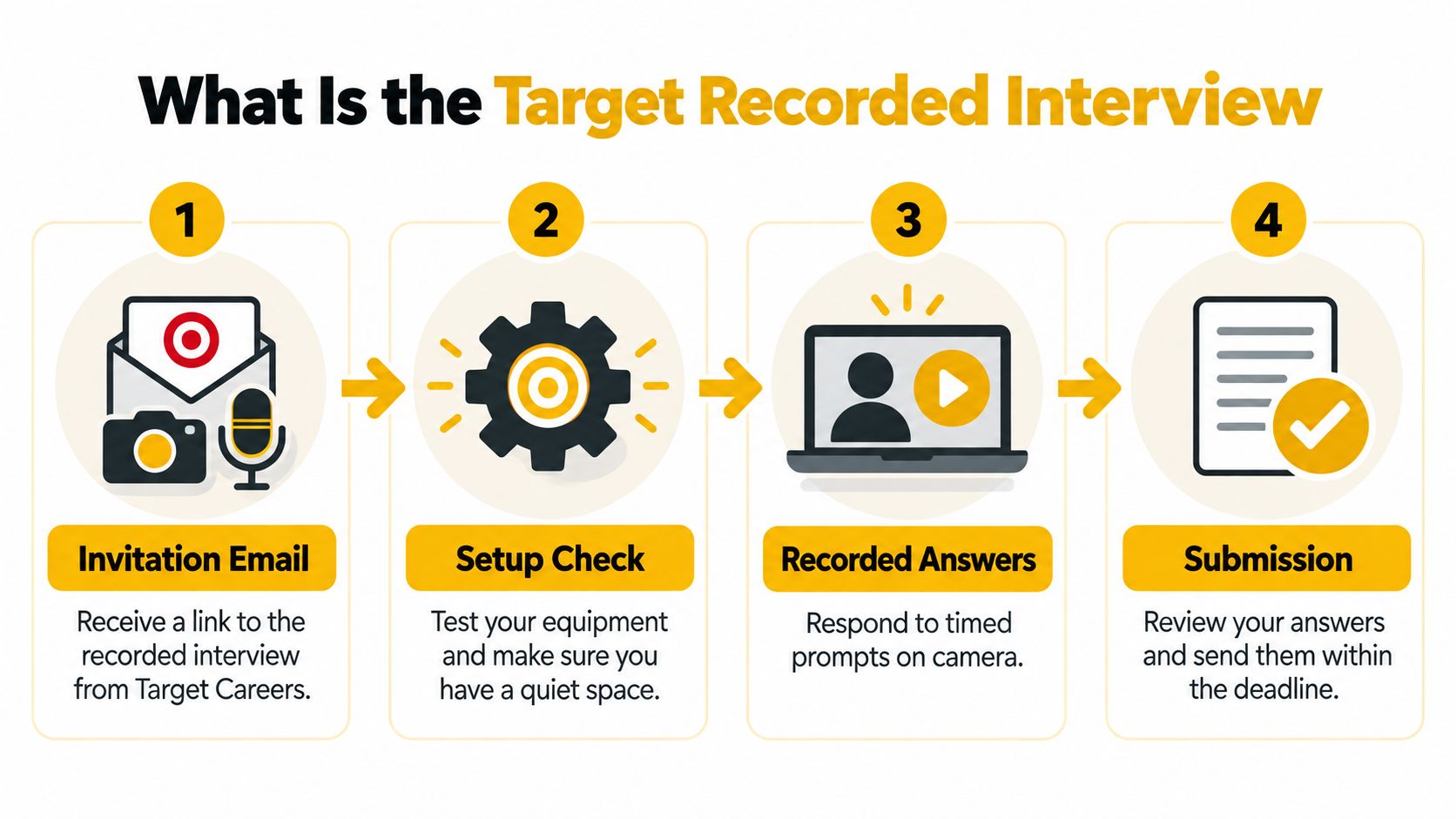
The process usually follows a simple sequence:
- Invitation email: You receive a message from Target Careers with a link to begin.
- Equipment check: You test your camera and microphone and confirm that your space works.
- Practice question: You try the format before recording official answers.
- Recorded prompts: You answer each prerecorded question on camera.
- Submission: Target reviews the final submitted versions rather than every discarded take.
Target allows candidates to re-record responses and says recruiters or hiring managers see only the final version. That means preparation isn't about delivering a flawless first take. It's about using the available control wisely, keeping your answer genuine, and making sure the version you submit is your strongest clear response.
If you want a second preparation resource, this guide to interviewing with Target can help you organize examples before you open the invitation. Write bullet points, not a speech. A recorded interview should feel considered, not memorized.
Step by Step Through the Interview Process
Treat the invitation as a short workflow, not as an unexpected performance test. Knowing the sequence removes avoidable stress and gives you a practical way to prepare your room, device, examples, and timing.
Start with the invitation
Open the email from Target Careers and follow its interview link when you can focus. The link takes you to a system that checks your camera and microphone, so don't wait until the last moment if you can avoid it. Use a smartphone, tablet, or computer with a working camera and microphone, all of which Target identifies as possible devices for the process.
Choose a quiet location with a stable surface for your device. Face a light source rather than placing a bright window behind you, and keep the background calm enough that the reviewer can concentrate on your answer.
Complete the setup and practice
The setup check confirms that your face and voice are captured clearly. Speak at your normal volume and listen for echo or muffled sound. The practice question isn't typically the part that determines your application, so use it to test eye contact, posture, answer length, and how quickly you can gather your thoughts.
Target recommends allowing approximately 30 minutes for setup, instructions, practice, and responses. The company's hiring-process page also describes the broader process as using multiple formats, including recorded interviews where applicants answer prerecorded questions for later review.
Record, review, and submit
Read each prompt carefully before answering. Use a brief pause to organize your response, then explain the situation, your action, and the result. If the first recording contains a technical problem or doesn't represent you well, use the re-record option thoughtfully rather than restarting endlessly over a minor imperfection.
Before submitting, check that every response is present and that the final takes are the versions you want reviewed. After submission, Target says a recruiter or hiring manager evaluates the video alongside your résumé and application, and the company generally responds within five business days. Target's recorded-video interview instructions provide that timing and review context.

Practical rule: Test the device you'll actually use. A camera that works on your phone may not work the same way in a browser on your laptop.
The Science Behind Recorded Interviews
A recorded interview isn't automatically fair or useful just because it uses technology. Its value comes from structure. When every candidate receives comparable questions and reviewers use consistent standards, the employer has a better basis for comparing evidence.
A meta-analysis found that interview structure was the only examined design characteristic that significantly moderated interview validity. The analysis estimated average observed validity at 0.27 and true validity at 0.38. The meta-analytic investigation of interview design also supports a practical conclusion: recording alone doesn't create a strong assessment. Standardized prompts, job-related competencies, consistent response expectations, and evidence-based scoring do.
Why consistency helps
A spontaneous conversation can vary because one interviewer probes intently while another moves quickly. One candidate may receive a helpful follow-up, while another has to explain everything in the initial answer. A structured recorded process reduces some of that variation by giving applicants the same basic prompt and allowing reviewers to compare responses against defined competencies.
For a retail role, those competencies might include customer judgment, collaboration, problem solving, and communication. For technology hiring, a rubric could distinguish debugging, algorithmic reasoning, system design, and technical explanation. The important point is that the reviewer should score what the answer demonstrates, not whether the candidate has a naturally polished camera presence.
Reliability still requires design
Research on an asynchronous recorded multiple-mini-interview assessment involving 712 applicants reported a mean Cronbach's alpha of 0.72, with a range of 0.64 to 0.89. The study also reported similar reliability across gender, age, disability or support-needs status, and domestic versus international applicant groups, while confirmatory factor analysis supported a seven-factor hierarchical model with CFI of 0.99, TLI of 0.99, and RMSEA of 0.034. The published assessment study illustrates why multiple job-relevant prompts and defined scoring rubrics matter.
For you, the practical lesson is simple. Don't treat one dramatic story as your entire application. Give several answers that each provide a different piece of evidence, and make every example easy to follow.
Interview stress can also affect how well you access experiences you already have. Candidates who want additional support for managing anxiety may find this resource on CBT and DBT for interview stress useful alongside practical rehearsal.
Why Preparation Really Matters
A recorded interview can feel easier because nobody interrupts you. That comfort creates the main trap. Candidates often prepare less, then discover that a camera exposes every weak transition, vague example, and unfinished thought without giving them a conversational partner to rescue the answer.
Target's interview guidance points applicants toward introductions, role explanations, concrete examples of past behavior, and responses to hypothetical business problems. Target's interview guide highlights themes such as relevant experience, working with people who think differently, solving problems, building relationships, and making work successful. Those prompts reward evidence, not general enthusiasm.
Build an evidence file
Before recording, list experiences from work, school, volunteering, sports, family responsibilities, or community activities. You don't need a prestigious job title. A busy food counter can demonstrate customer service and prioritization. A group project can show respectful disagreement. Organizing an event can reveal planning, communication, and follow-through.
For each experience, write four notes:
- Situation: What was happening, and why did it matter?
- Responsibility: What part belonged to you?
- Action: What did you do?
- Result: What changed, improved, or did you learn?
The word “result” doesn't require a number. You can describe a smoother handoff, a resolved customer issue, a completed project, or a lesson you applied later.
Rehearse without becoming mechanical
Record practice answers on your phone and watch them once with the sound on. Notice whether you answer the question directly, whether your actions are clear, and whether your ending explains what you learned or achieved. Then practice again using only keywords.
AI tools can support this rehearsal when you use them as a practice partner rather than as a scriptwriter. For example, Interview Pilot offers guided mock interview practice and can generate suggested responses during live online interviews, but you should use its rehearsal capability to clarify your own experiences for a Target recording. Your final answer should remain accurate, personal, and consistent with your application.
A strong rehearsal question: If the reviewer remembers only one thing about this answer, what evidence do I want that to be?
Preparation also helps you manage the strange silence of a recorded format. A short pause before speaking looks thoughtful, not incompetent. A practiced structure keeps that pause from turning into rambling.
How to Answer Target Competency Questions
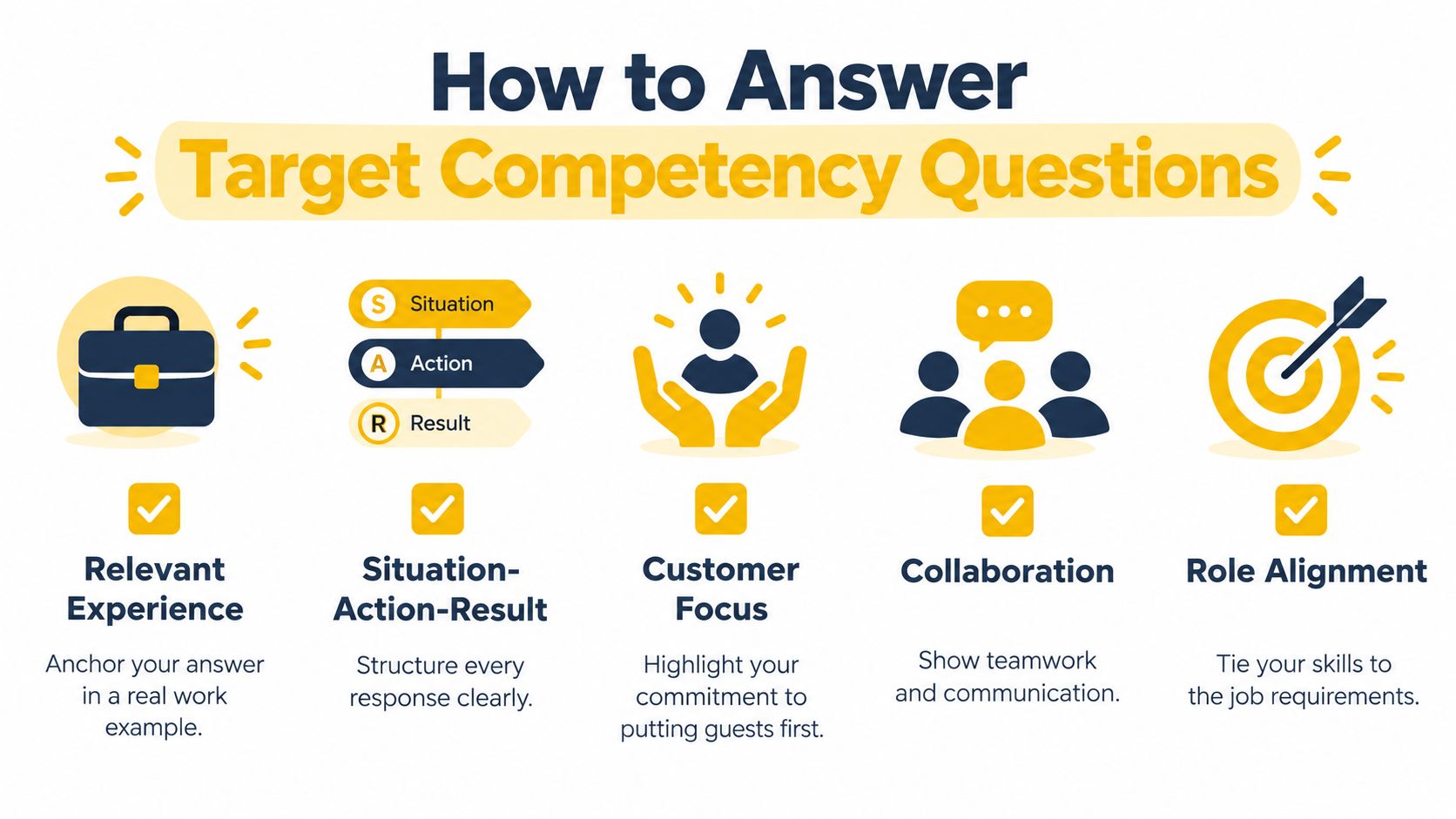
Target's questions ask you to show how you behave, not merely to announce that you're friendly, hardworking, or a team player. The strongest recorded answers connect a real situation to a specific action and then explain why that action mattered.
Use a flexible version of STAR, but make it more camera-friendly:
- Situation: Give enough context to orient the reviewer.
- Task: State the responsibility or problem.
- Action: Spend most of your time on what you did.
- Result: Close with the outcome, lesson, or role connection.
Turn broad prompts into evidence
For “Tell us about relevant experience,” choose one example that resembles the job. Explain the setting, the pressure or responsibility, your contribution, and what the experience taught you about serving people or completing work accurately.
For a question about people who think differently, avoid saying only that you respect differences. Describe a disagreement, explain how you listened, identify what you changed or combined, and show how the group moved forward. That demonstrates inclusion through behavior.
For problem solving, explain your decision path. What did you notice first? What options did you consider? Who did you involve? A reviewer can learn more from your reasoning than from a dramatic story with no clear action.
Adapt the same story to the role
One truthful story can support several applications, but its emphasis should change.
- Store roles: Highlight guest service, reliability, task switching, teamwork, and calm judgment during busy periods.
- Corporate roles: Emphasize stakeholder communication, organization, analysis, and how you moved a project toward completion.
- Technology roles: Focus on debugging, trade-offs, learning, documentation, and explaining technical decisions clearly.
- Supply-chain roles: Show accuracy, safety awareness, prioritization, process discipline, and communication when conditions change.
Don't force retail language into an unrelated story. Instead, connect the transferable behavior to the position. A group project becomes relevant when you explain how you coordinated responsibilities, handled a disagreement, and delivered the shared outcome.
The delivery should sound like you're explaining the experience to a helpful manager, not reciting an essay. Keep bullet prompts near the camera if needed, but don't read full sentences. For more practice with structure, this behavioral interview answer guide can help you turn experiences into concise evidence.
Recorded vs Live Interviews Compared
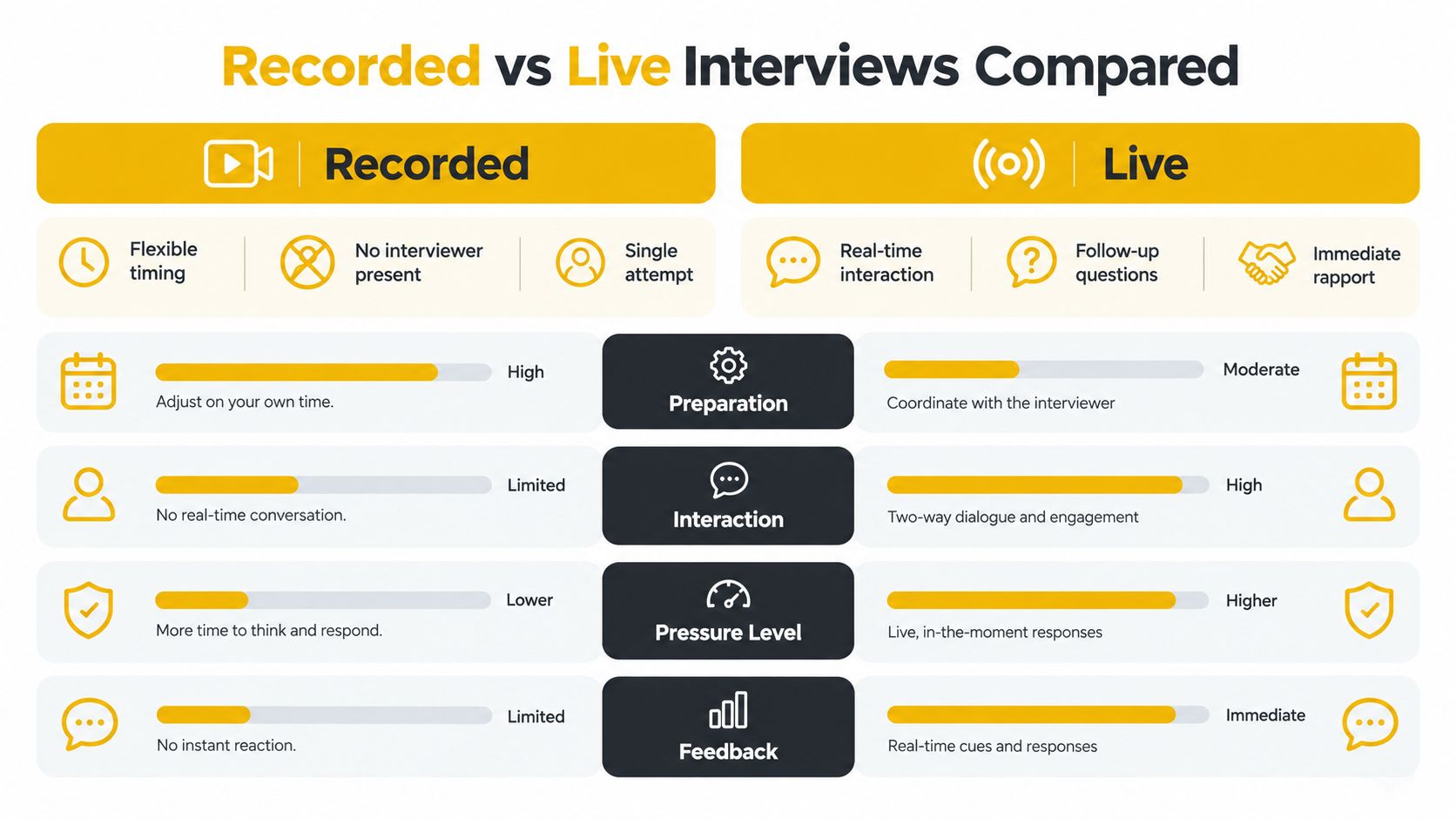
Recorded and live interviews test overlapping skills, but they create different conditions. A live conversation gives you interaction. A recorded interview gives you control over when you begin and, in Target's process, an opportunity to re-record before submission.
| Area | Recorded interview | Live interview |
|---|---|---|
| Preparation | You can organize examples before starting | You prepare, then respond in real time |
| Interaction | The prompt is fixed and there may be no follow-up | The interviewer can clarify and probe |
| Pressure | Less immediate social pressure, more camera awareness | More conversational pressure and instant judgment |
| Feedback | You may receive no immediate reaction | Facial expressions and follow-up questions provide signals |
When recorded can work in your favor
Candidates who need a moment to organize their thoughts may prefer the recorded format. You can check your equipment, use the practice question, and deliver an answer without an interviewer's expression changing while you speak. The absence of follow-up questions also means you can prepare for the major competency themes in advance.
The challenge is that you must supply your own energy and context. A live interviewer may notice that you're nervous but capable and invite you to expand. A recorded reviewer sees the response you submit, so your answer needs a clear beginning, middle, and ending.
When live interaction helps
Live interviews are useful when your strengths appear through dialogue. You may explain complex situations better after a follow-up, build rapport naturally, or ask questions that create a genuine exchange. They can also expose weaknesses more quickly if you haven't prepared examples or tend to answer indirectly.
Preparation tools should match the format. A question bank and mock interview can help with either style, while real-time assistance belongs only in contexts where its use is permitted and appropriate. For additional practice with a common recorded-interview format, this guide to HireVue interview questions can help you rehearse concise answers without confusing practice with the actual assessment.
Common Mistakes to Avoid
The absence of a live interviewer doesn't make the Target recorded interview casual. It removes some social pressure, but it also removes the person who might discreetly steer you back to the question. Small preparation failures therefore become more visible.
Technical problems weaken good answers
A reviewer can't evaluate your customer judgment if the microphone produces static or your face is hidden in shadow. Test the camera and microphone through the interview system, not just through a separate app. Keep your device stable, silence notifications, charge the battery, and choose a background that won't distract from your face.
A quiet setting matters for another reason. You need to hear each prompt accurately, especially when the question contains multiple parts. If you're uncertain about the wording, pause and read it again before recording rather than answering a question you imagined.
Reading a script flattens your delivery
Full sentences on paper encourage your eyes to move away from the camera and your voice to become even. Use three or four keywords instead: “guest issue,” “checked options,” “involved teammate,” “resolved outcome.” Those prompts preserve your natural language while keeping the answer organized.
Camera test: Record one practice answer, then check whether your eyes, voice, and hands look natural. Adjust the setup before you begin the official responses.
Vague examples leave the reviewer guessing
“I'm a great team player” is a claim. “I noticed two teammates were handling overlapping tasks, clarified who owned each step, and helped us finish the event setup” is evidence. Your answer doesn't need to sound grand. It needs to make your personal contribution unmistakable.
Don't hide behind “we” for the entire story. Explain what the group accomplished, then identify your decisions, communication, and follow-through. At the same time, don't turn teamwork into a solo-hero story. Show what the other person contributed and how you worked together.
Re-recording isn't a reason to chase perfection
Use another take when the answer is incomplete, technically poor, or unrelated to the prompt. Keep a solid response if it contains a small pause or natural phrase. Excessive restarting can make you tense and may prevent you from submitting an answer that was already clear.
Finally, don't overlook the closing sentence. Tie the lesson to the role, the guest experience, teamwork, accuracy, or the responsibility named in the question. That final connection helps the reviewer understand why your example belongs in a Target application.
Interview Pilot offers guided AI mock interviews, a searchable question bank, and profile-based practice for behavioral and technical questions, with apps for macOS, Windows, iOS, and Android. Use it to rehearse Target-style competency answers, refine your structure, and build confidence before you submit your recording by visiting Interview Pilot.
Topics
target recorded interview
target interview
video interview guide
target careers
recorded interview tips
Continue reading

Interviews
8 Common HireVue Interview Questions and Tips for Acing Your Video Interview
Prepare for HireVue interview questions with sample answers, recording tips, and a simple framework for answering clearly when you only get one take.
July 6, 2026
10 min read

Interviews
10 Behavioral Interview Questions for Managers, Explained
Explore 10 behavioral interview questions for managers with answer frameworks, sample responses, and prep tips for leadership interviews in 2026.
October 11, 2026
25 min read

Interviews
Interview with Target: A Practical Guide to Getting Hired
Prepare for an interview with Target as a candidate. Learn the hiring process, formats, and targeted strategies to succeed at every stage.
October 10, 2026
14 min read