









Interviews
SOAR Method for Interview Answers: Use the Right Version
Learn the Situation, Obstacle, Action, Result version of SOAR for interviews while avoiding confusion with other frameworks that use the same acronym.
Interview Pilot Editorial Team
2 min read
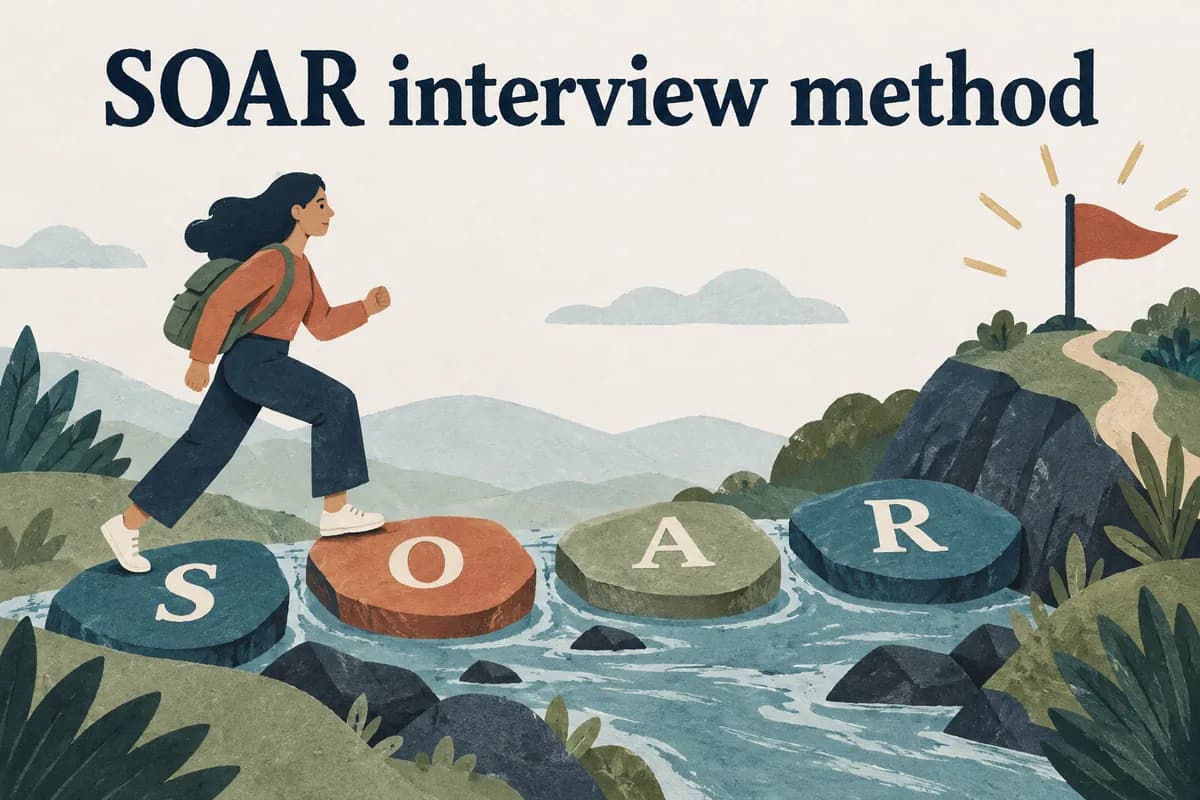
For behavioral interviews, SOAR commonly means Situation, Obstacle, Action, and Result. It can produce a clear answer when the obstacle is the most important part of the story. Because other career resources use SOAR differently, name the four elements when you practice rather than relying on the acronym alone.
The University of Maryland's economics career resource uses Situation, Obstacle, Action, Result to frame accomplishments. That is the version used here.
Define SOAR before you use it
- Situation: the setting, goal, and relevant responsibility
- Obstacle: the specific barrier, uncertainty, or constraint
- Action: the steps and decisions you personally made
- Result: the outcome, evidence, and learning
Do not say “I used SOAR” in an interview unless asked about your structure. The interviewer needs the story, not the label.
Separate the obstacle from the situation
The situation might be a planned software migration. The obstacle could be that the available customer records used incompatible identifiers. This distinction prevents a common weak answer in which the opening consumes most of the time but never identifies what made the work difficult.
An obstacle is not automatically a crisis. Limited time, unclear ownership, conflicting requirements, or unfamiliar material can all be legitimate if they materially affected your approach.
SOAR answer example
Question: “Tell me about a time you had to learn quickly.”
Situation: I inherited the weekly inventory report while its owner was on leave. Obstacle: I knew the spreadsheet but not the warehouse exception codes, and the report was due in two days. Action: I reviewed the procedure, listed the codes I could not validate, and booked a short check with the warehouse lead. I processed a small sample first and reconciled it against the previous week before completing the report. Result: I delivered on time with two exceptions explicitly flagged, then added the verified code definitions to the team instructions.
The response shows learning through controlled verification, not instant expertise. See our learning-something-quickly guide for more ways to choose evidence.
Choose SOAR or STAR deliberately
SOAR and the STAR interview method both organize evidence. Use SOAR when naming the barrier makes your reasoning easier to follow. Use STAR when the task or responsibility deserves separate explanation.
The framework cannot rescue a vague example. Start with a real event, keep the opening short, make your action observable, and state only results you can support.
Topics
interviews
answer frameworks
behavioral interviews
Continue reading

Interviews
CAR Method for Interview Answers: Challenge, Action, Result
Use the CAR interview method to turn a real experience into a concise answer that makes your decision, contribution, and result easy to evaluate.
October 29, 2026
3 min read

Interviews
How to Answer "Are You Interviewing With Other Companies?"
Answer honestly without naming employers or inventing offers, with examples for early conversations, final rounds, and a real deadline.
October 29, 2026
3 min read

Interviews
How to Answer Inappropriate Interview Questions Without Losing Focus
Respond to an intrusive or potentially discriminatory interview question by clarifying relevance, redirecting to job evidence, or ending the conversation.
October 29, 2026
3 min read