
















Resume & Cover Letter
Operations Manager Resume: Show the Process Behind the Result
Write an operations manager resume that connects staffing, workflow, capacity, and quality decisions to clearly scoped operational outcomes.
Interview Pilot Editorial Team
3 min read
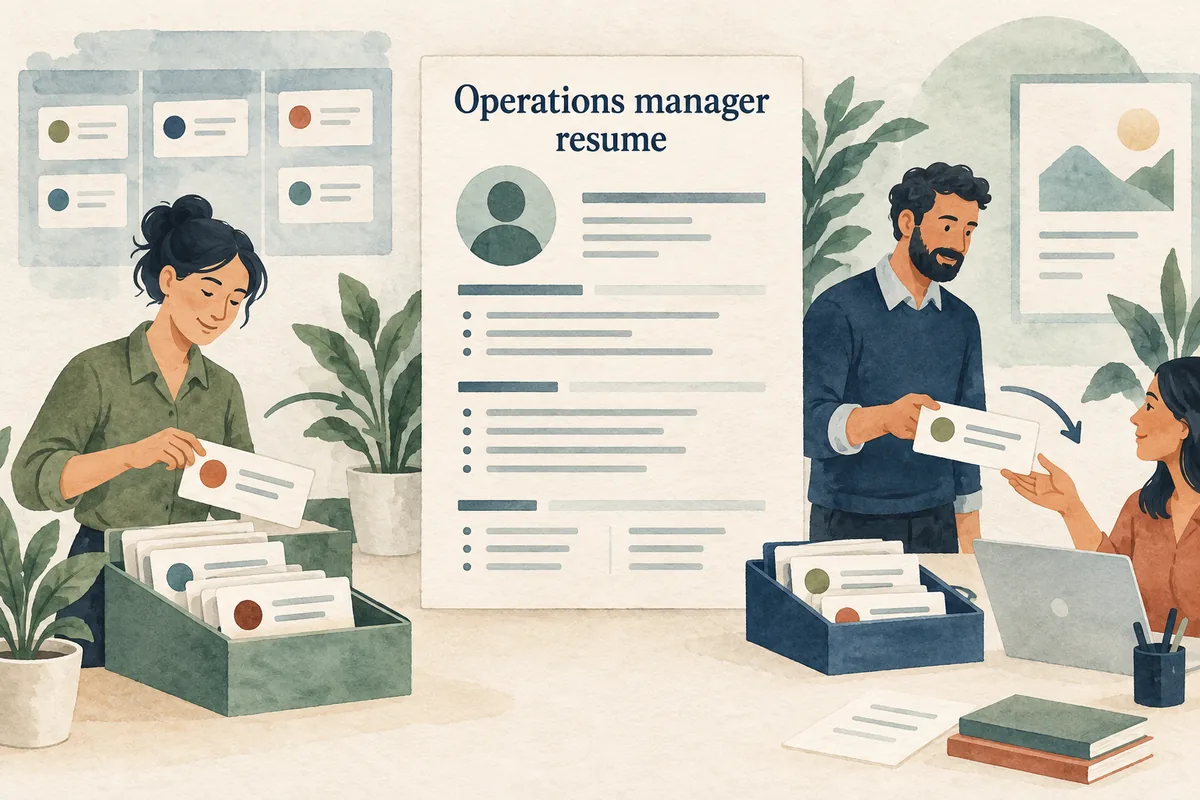
An operations manager resume should show how you improved the way work moved through an organization. "Managed daily operations" is a starting point, not an achievement: what did you oversee, which constraint mattered, and what changed?
O*NET's general and operations manager profile covers a broad range of responsibilities. Your own resume should be narrower. Name the site, service, process, or team you managed without suggesting responsibility for operations you did not control.
Establish scale without relying on scale alone
Relevant context might include shifts, locations, service volume, direct reports, or budget responsibility. Distinguish direct reports from the total workforce affected by a process.
After the scope, show a decision. Did you adjust staffing, clarify a handoff, remove rework, change scheduling, or improve the visibility of a queue? A larger team size does not automatically demonstrate better management.
Describe the constraint you addressed
A fictional bullet might read:
Redesigned the intake handoff between service and fulfillment teams, adding required information checks and an owner for exceptions before work entered the queue
This explains a mechanism. If measured results are available, add a relevant outcome. If they are not, the concrete process change is still more credible than an invented efficiency percentage.
Another example could highlight people leadership:
Cross-trained shift leads on the revised escalation process and reviewed unresolved cases weekly to identify repeat handoff failures
The examples serve different purposes. One concerns workflow design; the other concerns adoption and follow-through.
Pair speed with quality
If completed work increased, check whether hours, staffing, task complexity, or quality changed too. Moving unfinished cases to another team is not the same as resolving them faster.
For a fictional comparison, completing 240 cases in 120 staff-hours gives two cases per staff-hour. Completing 300 in 150 hours gives the same rate. Output rose, but this calculation alone does not show improved labor productivity.
Even a better rate needs context: rework, error rates, service levels, and employee workload may matter. Use the metric that reflects the intended improvement rather than the one with the largest percentage.
Show how you sustained the change
Useful evidence includes documented ownership, training, review cadence, and an exception process. A one-time cleanup differs from a process that continued working after you stopped personally chasing every task.
If the result was a team effort, state your contribution. Avoid implying that you alone caused an organization-wide outcome influenced by demand, investment, or other departments.
Tailor to the operating environment
A service operation, warehouse, and multi-location business have different constraints. Reorder your evidence accordingly instead of sending the same broad summary everywhere.
Use mid-career resume summaries to state your scope and resume bullet examples to keep the process, decision, and result visible in a small amount of space.



Topics
Resume & Cover Letter
operations manager resume
Continue reading

Resume & Cover Letter
Mobile Developer Resume: Prove Behavior on Real Devices
Write a mobile developer resume that explains platform scope, app behavior, release work, and device-level verification without vague performance claims.
November 28, 2026
3 min read

Resume & Cover Letter
Machine Learning Engineer Resume: Show What Reached the Serving System
Write an ML engineer resume that separates experiments from deployed systems and makes evaluation, reproducibility, and serving work clear.
November 27, 2026
3 min read

Resume & Cover Letter
Marketing Manager Resume: Connect Strategy, Budget, and Results
Write a marketing manager resume that shows campaign decisions, resource allocation, team leadership, and carefully attributed business results.
November 27, 2026
3 min read