
















Interviews
Manufacturing Engineer Interview Questions: Diagnose Before You Optimize
Practice manufacturing engineering interview questions on yield, throughput, trials, recurring defects and process changes with a worked production example.
Interview Pilot Editorial Team
4 min read

A manufacturing engineering interview often turns on whether you can improve a process without moving the problem somewhere else. Faster equipment is not automatically better production if defects, rework or downstream queues increase.
O*NET's manufacturing engineer profile includes process improvement and work involving quality, reliability and cost. Use the actual vacancy to decide whether to emphasize process development, production support, industrialization or another specialty.
The questions below are original practice scenarios. They do not prescribe operating settings, machine interventions or safety procedures.
How would you investigate a fall in first-pass yield?
Define the metric and confirm the data before selecting a cause. Which products, shifts, machines and time periods are included? Did the process change, or did the inspection method or recording rule change?
Consider a fictional shift with 1,000 units entering a process. Of those, 920 pass without rework, 50 pass after rework and 30 are scrapped. First-pass yield is 92%. Eventual accepted output is 970 units, or 97% of the original input. Reporting only 97% hides the rework burden.
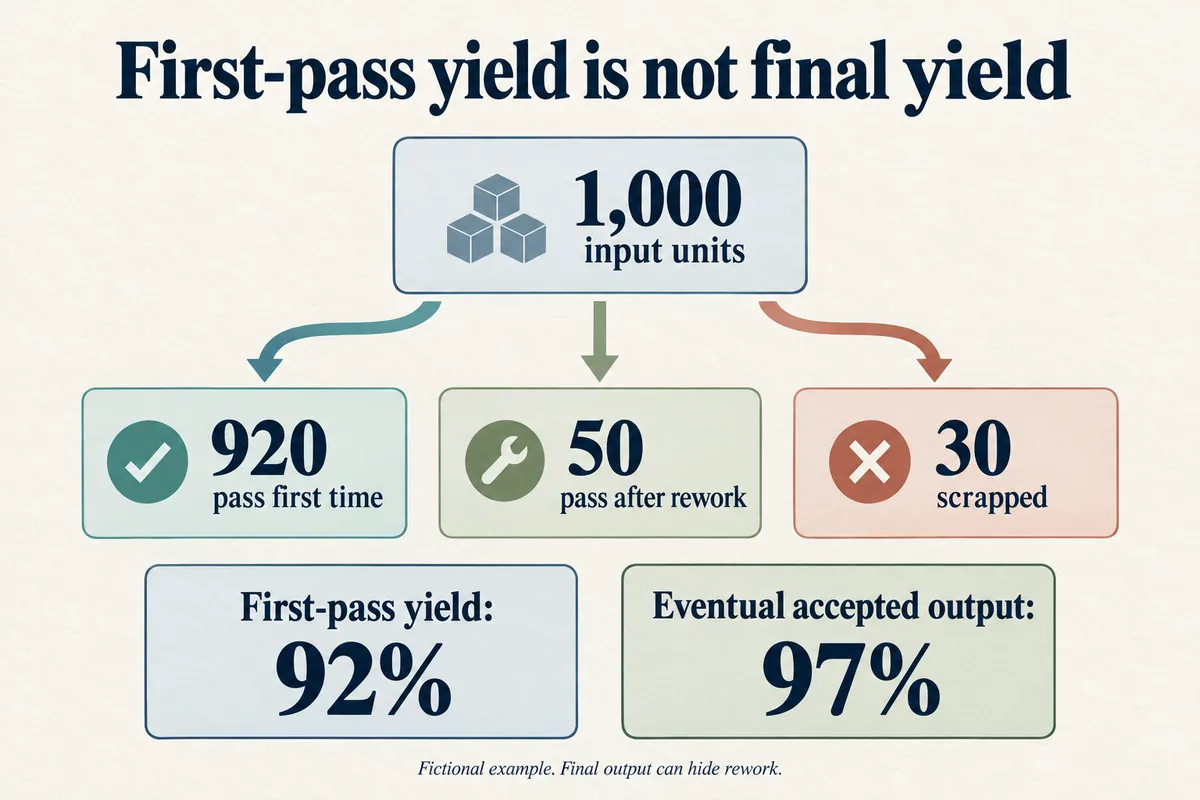
That distinction should shape your next questions. What defects drove the 80 first-pass failures? Were they concentrated after a material change, on one product or at a particular process step? Do not assume that the largest category is the root cause merely because it is easy to count.
What would you check before increasing line speed?
Explain the current constraint, downstream capacity, quality requirements and conditions under which a trial would be authorized. A machine's nominal rate does not describe the whole line's accepted output.
For example, a 10% increase in an upstream rate does not guarantee a 10% increase in shipped units. The downstream operation might already be limiting the flow. An interview answer should connect the proposed change to the system rather than celebrate an isolated number.
How would you design a useful improvement trial?
State the hypothesis, comparison, measures and stopping conditions. Identify who must approve the trial and how normal production is protected. Keep product mix, measurement method and other relevant conditions visible so you do not attribute every difference to your change.
A sample answer might be: "I would agree what improvement means before running the trial, measure accepted output and rework as well as cycle time, and document other changes during the period. I would review the result with production and quality before recommending wider use."
This is an answer structure, not a claim that every trial needs the same statistical design.
A defect returns after a fix. What do you do?
Distinguish containment from lasting correction. Explain what the first action addressed, what evidence supported the suspected cause and what verification showed. Replacing a component may restore production without establishing why it failed.
Use a real example where you revised your hypothesis if possible. For technical questions you cannot fully answer, a clear investigation plan is more credible than invented certainty.
How do you get operators involved?
Describe how you gather observations, test assumptions with the people doing the work and communicate approved changes. Avoid treating operator feedback as either unquestionable proof or an obstacle to engineering.
Prepare an example of adapting a work instruction or proposed improvement after practical feedback. Explain how training, documentation and ownership were handled so the change did not depend on your continued presence.
How should you describe impact?
Give the baseline, denominator and period. Separate a short trial from a sustained result, gross savings from net savings, and a team outcome from your personal contribution. If you only estimated annual savings, call them estimates and explain the assumptions.
For preparation, select one quality problem, one throughput decision and one implementation example. Our technical interview preparation guide can help you rehearse the reasoning clearly without turning the conversation into an acronym list.


Topics
Interviews
manufacturing engineer interview questions
Continue reading

Interviews
Policy Analyst Interview Questions: Turn Evidence Into a Decision
Practice policy analyst interview questions about problem definition, options, uncertainty, distributional effects and concise recommendations.
November 18, 2026
4 min read

Interviews
Auditor Interview Questions: Defend the Evidence, Not Just the Checklist
Prepare for auditor interviews with practical questions on evidence quality, exceptions, sampling, documentation and constructive challenge.
November 16, 2026
4 min read

Interviews
Chef Interview Questions: Service, Consistency and Kitchen Leadership
Prepare chef interview answers about service planning, consistency, food cost, team communication and responding responsibly when a service problem arises.
November 16, 2026
4 min read