
















Interviews
How to Prepare for a Live Coding Interview
Practice the complete live-coding loop, from clarifying a problem through testing and explaining complexity, with a worked duplicate-detection example.
Interview Pilot Editorial Team
4 min read
Practice solving a problem while making your reasoning visible. Live coding combines implementation, clarification, testing, and conversation. Reading solutions without reproducing those steps leaves a gap between knowing an approach and using it under interview conditions.
Amazon's SDE preparation material is one employer example that emphasizes working code, edge cases, and explanation. Your interview may instead involve debugging or modifying an existing codebase, so confirm the format with your recruiter first.
Rehearse in the environment you will use
Find out which languages are allowed, whether code can run, what editor is provided, and which documentation or tools are permitted. For a shared-screen session, check the editor's font size, audio, and screen-sharing controls.
Choose a language you can use reliably rather than one that sounds more impressive. Practice basic collection operations, sorting, function definitions, and testing without constantly searching syntax. Follow the assessment's rules on external help and AI assistance.
Use a complete problem-solving loop
Start by restating the task and asking about inputs, outputs, and constraints. Then outline a simple correct approach, discuss its cost, implement it, and test it. Improve the solution where the constraints justify doing so.
Do not narrate every keystroke. Explain decisions: "I need to remember previously seen values, so I'm considering a set." If you need a quiet moment, say what you are checking.
Worked example: finding a repeated value
Consider this original practice prompt: Given a list of integers, return whether any value appears more than once.
First clarify whether the list can be empty and whether modifying it is allowed. For this exercise, an empty list returns false and the input should stay unchanged.
A straightforward approach compares every pair. It uses little extra storage but takes quadratic time in the worst case. A set offers a different trade-off: scan the values, returning true when a value is already present; otherwise add it to the set.
In pseudocode:
seen = empty set
for each value in values:
    if value is in seen:
        return true
    add value to seen
return false
With expected constant-time set operations, this takes expected O(n) time and O(n) additional space. State that assumption rather than claiming every set implementation guarantees it.
| Input | Expected result | Why test it? |
|---|---|---|
| Empty list | false | No pair exists |
| One value | false | A value is not its own duplicate |
| 4, 7, 4 | true | A repeated value need not be adjacent |
| 0, -2, 5 | false | Values need not be positive |
| 8, 8 | true | Smallest duplicate case |
Walk through one example against the actual code, not just the algorithm you intended to write. This can expose placing the return statement inside the loop or forgetting to add a value.
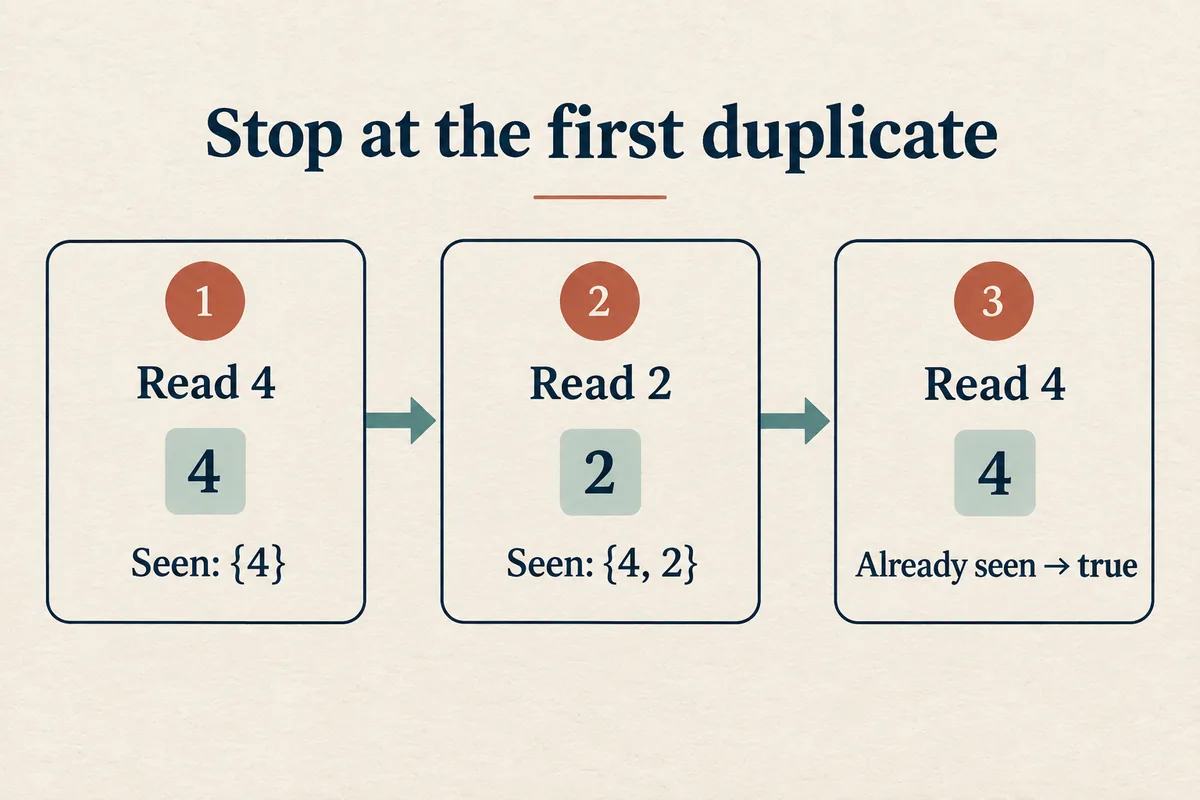
For another short trace, the list [4, 2, 4] stops at the third value because 4 is already in the set.
Recover from a mistake systematically
If the output is wrong, identify the smallest failing input, trace the relevant state, and change one cause at a time. Do not rewrite the entire solution because of a single indexing error.
If you get stuck on the approach, explain the partial understanding and the specific obstacle. "I can find a correct answer by comparing pairs, but I'm looking for a way to avoid repeated work" is more useful than silence. See also what to say when you do not know a technical answer.
Review the practice session, not only the final code
After a mock interview, note where time went: understanding, choosing a method, syntax, testing, or communication. Choose the next exercise to address that bottleneck. If you implemented quickly but never checked an empty input, doing ten more problems at the same speed will not fix the missing habit.
Use the broader technical interview study plan for coverage. Use live practice to make that knowledge accessible in a conversation.
Topics
interviews
how to prepare for a live coding interview
Continue reading

Interviews
How to Improve a Low Interview-to-Offer Rate
Diagnose where interviews break down, collect usable evidence, and run focused practice without relying on a universal success-rate benchmark.
November 9, 2026
2 min read

Interviews
How to Prepare for an Asynchronous Video Interview
Prepare for a one-way recorded video interview by checking the format, practicing concise responses, testing equipment, and planning for technical problems.
November 9, 2026
2 min read

Interviews
How to Prepare for a HireVue Interview
Prepare for a HireVue interview by following the invitation, testing your setup, practicing recorded answers, and handling platform or accessibility questions early.
November 9, 2026
2 min read