









Interviews
How to Prepare for a Case Interview
Prepare for case interviews by clarifying the decision, structuring the investigation, checking calculations, and making a recommendation supported by evidence.
Interview Pilot Editorial Team
3 min read

Practice turning an unfamiliar business question into a structured investigation and a supported recommendation. A case interview is not mainly a test of whether you can name a framework. You need to decide what information matters, work with it accurately, and explain what follows.
McKinsey describes its case interview as a business scenario used to explore analytical thinking and problem solving. Formats differ across employers, so ask whether yours includes interviewer-led questions, independent analysis, exhibits, or a presentation.
Clarify the decision before building a structure
Restate the objective in concrete terms. "Should we expand?" could mean increasing profit, reaching more customers, entering a region, or meeting a service commitment. Ask about the time horizon and important constraints.
Then propose a short structure tailored to the decision. For a capacity expansion, you might investigate demand, unit economics, operating constraints, and implementation risk. Explain why each branch matters. Do not force every case into the same memorized headings.
Work a small example carefully
Imagine a fictional company that runs paid workshops. It currently sells 800 places a month at $50 each. Variable cost is $20 per place and fixed monthly cost is $18,000. The question is whether adding sessions would improve monthly profit.
Current contribution per place is $50 minus $20, or $30. Total contribution is 800 times $30, or $24,000. After fixed costs, monthly profit is $6,000.
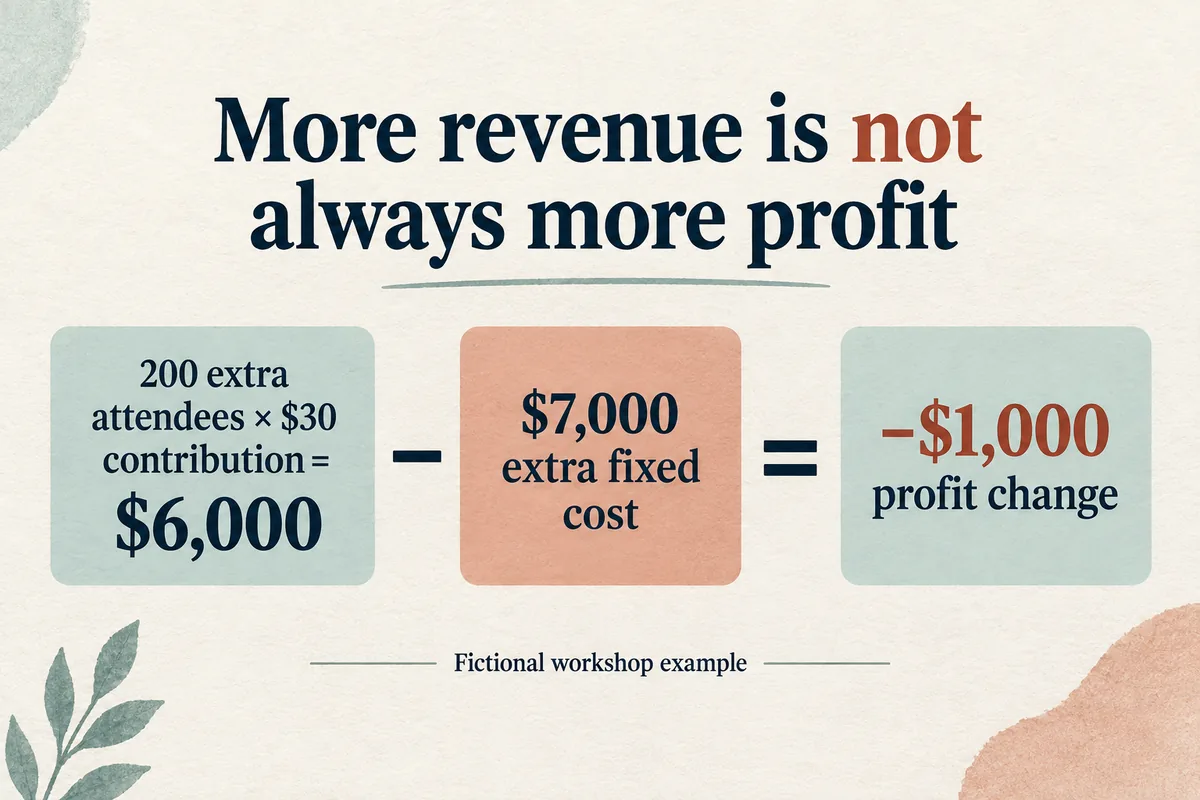
Suppose expansion would sell 200 additional places without changing price or variable cost, but require $7,000 more in monthly fixed costs. Additional contribution would be $6,000, so monthly profit would fall by $1,000. More revenue does not automatically mean more profit.
The incremental break-even volume is $7,000 divided by $30, or about 233.3 places. Since places are whole units, the expansion needs at least 234 additional paid places under these assumptions. That is a calculation, not evidence that demand exists.
Explain what the numbers do not establish
A reasonable recommendation is to delay full expansion until demand and costs are tested. You could investigate a smaller pilot, different scheduling, or another way to use existing capacity. Do not recommend a price increase without considering whether customers would still book.
State the assumptions explicitly: all additional places are sold, existing sales are not displaced, and per-place economics stay unchanged. If any assumption changes, recalculate the recommendation.
Practice interpreting an exhibit aloud
When shown a chart or table, check the title, units, period, and population before calculating. Distinguish a percentage change from a percentage-point difference. Describe the important pattern, not every number on the page.
If you make an arithmetic error, correct it and update the conclusion. Hiding the error or continuing with a result you know is wrong makes the discussion harder to follow.
Finish with a decision and a next test
Use a short closing structure: recommendation, strongest evidence, main risk, and next step. For the example above: "I would not add all the sessions yet. The projected extra contribution does not cover the new fixed costs. I would first test whether enough additional demand exists or whether a smaller expansion changes the economics."
Review practice cases for missed assumptions and unclear reasoning, not just whether your conclusion matches a model answer. Prepare personal examples separately using the behavioral interview guide; a strong case discussion does not replace the rest of the interview.
Topics
interviews
how to prepare for a case interview
Continue reading

Interviews
Questions to Ask a Recruiter
Choose recruiter questions that clarify the role, practical requirements, and hiring process, without using your entire call as a checklist.
October 15, 2026
3 min read

Interviews
How to Answer “Tell Me About a Time You Missed a Goal”
Learn how to answer “tell me about a time you missed a goal” with ownership, STAR structure, and examples that show growth instead of excuses.
August 24, 2026
8 min read

Interviews
What to Say When You Don't Know the Answer in a Technical Interview
Use this exact framework, sample scripts, and examples to answer technical interview questions when you do not know the answer.
August 23, 2026
10 min read