
















Interviews
Codility Test: How It Works and How to Pass It
What a Codility test is, how its hidden-test scoring works, whether it uses a camera, and how to prepare for the timed task and the live interview after it.
Interview Pilot Editorial Team
Updated November 27, 2026
13 min read

Codility Test: How It Works and How to Pass It

A Codility test is a timed online coding assessment that an employer sends you before, or alongside, the interviews. You solve programming tasks in a browser editor, and hidden test cases score your code automatically. The test is only the first gate. The live technical interview after it is where you explain your thinking out loud, and that is the part we help with at Interview Pilot, our real-time AI interview assistant for live online interviews. This guide covers the test itself first, then the conversation that follows.
TL;DR
- A Codility test is set by the employer: they choose the time limit, the pass mark, the monitoring and the rules on AI. There is no universal pass score.
- Your score is the share of hidden test cases your code passes, so edge cases (empty input, one element, maximum size) matter more than the examples you can see.
- Assessments typically run from 30 minutes to 2 hours, and the timer cannot be paused once it starts.
- Camera and monitoring features are switched on by the employer. The intro page tells you what applies before the clock starts.
- Passing the test usually leads to a live interview, where you explain your code and approach. Prepare for that conversation as seriously as for the test.
What a Codility test is and why employers use it
Codility is a technical screening platform. Codility says more than 20,000 engineering teams use it, and that results can flow into applicant tracking systems such as Greenhouse, Lever, Workday and SmartRecruiters. An applicant tracking system is the software a company uses to manage candidates through its hiring pipeline.
The point for the employer is volume. A recruiter cannot hold a live coding session with every applicant, so a standard test filters the pool first. For you, that means the test often arrives right after your application or a recruiter call, and it often decides whether you get a human conversation at all.
Codility says its task library holds more than 1,300 validated tasks across 80+ languages and frameworks. You will usually be able to pick from the languages the employer enables, so choose the one you can write fastest and debug most calmly, not the one that looks most impressive.
What the tasks look like
Codility’s Task Library help article describes three skill areas an employer can assess:
- Real-life skills: tasks in frameworks such as React, Spring or .NET.
- Problem-solving skills: algorithm questions, bug-fixing and general coding.
- Technical knowledge: multiple-choice sets, typically about 10 questions.
For a typical graduate or general software role, expect one to three algorithmic tasks: working with arrays, strings, counting, sorting, or simple data structures. Role-specific tests lean on the framework in the job description. Read the job post closely, because it is the best hint of what the employer picked.
How the test runs: time, setup and the intro page
Your invitation email shows the time limit and the deadline. According to Codility’s candidate page, the intro page explains the tasks and rules, including whether AI tools are allowed, before the timer starts. You can open the link early and start later, as long as you finish before the deadline.
A few practical facts from Codility’s help center:
- Assessments typically last between half an hour and two hours, and the test administrator sets the limit.
- The timer cannot be paused once you start.
- Time taken does not factor into the automated score. Finishing with minutes to spare earns no bonus.
- When time runs out, whatever is in the editor is submitted automatically.
One first-hand account, a C++ developer’s write-up of his Codility test, describes a minimal browser editor with a Run Code button you can use as often as you like, a Submit button that locks the task, and a countdown timer. That matches what most candidates describe: no autocomplete-heavy IDE, so know your language’s syntax cold.
Treat the open-early option as a gift. Open the link, read the intro page and rules, and confirm your setup works. Then start the timer only when you have a quiet hour or two and a charged laptop.
How Codility scores your code
This is where most candidate frustration comes from, so it is worth understanding properly.
According to Codility’s scoring principles, every task has at least 6 test cases. Your score is the share of hidden test cases you pass: 6 of 10 passed means 60%. Correctness tests apply to every task. Performance tests, based on Big O notation (a way of describing how running time grows with input size), apply only to algorithmic tasks.
The practical consequences:
- Passing the visible examples proves little. The examples are a small sample. The hidden cases are where wrong assumptions show up.
- A brute-force solution can be correct and still lose points. If the task is algorithmic and your approach is too slow on large inputs, the performance cases fail.
- Partial credit exists. A solution that handles most cases beats a blank screen.
Codility’s own analysis of Reddit threads about its tests acknowledges that the hidden-test mechanic is the main source of candidate frustration, including a candidate who passed the example scenarios and still scored 0%. It also says the employer sets the pass mark and that a person at the employer reviews the results and decides how to read them.
The edge cases to test before you submit
Before you press Submit, write your own quick tests for:
- an empty input
- a single element
- all values identical
- negative numbers and extreme values
- the maximum input size the task allows
These are the cases hidden suites are built around. Use the Run Code button freely, since it does not cost you anything, and add small cases of your own.
Does Codility use a camera?
Only if the employer turns it on. Codility’s candidate experience page states that snapshots may be taken during assessments, and that extended-time accommodations are configured per candidate by the hiring team. Stricter modes exist, and the employer chooses them when sending the invitation.
The reliable way to know what applies to you is the intro page. If a camera, microphone or screen-sharing step appears before the Start button, monitoring is active. Codility’s Screen Setup Check article explains that the preflight check tests camera, microphone, screen sharing, displays, browser and connection. Blocking issues must pass before Start is enabled, and tests without proctoring only run a connection speed test. For video proctoring it lists Chrome 137+, Chromium Edge 137+ or Opera 118+, and says Safari and Firefox are not supported.
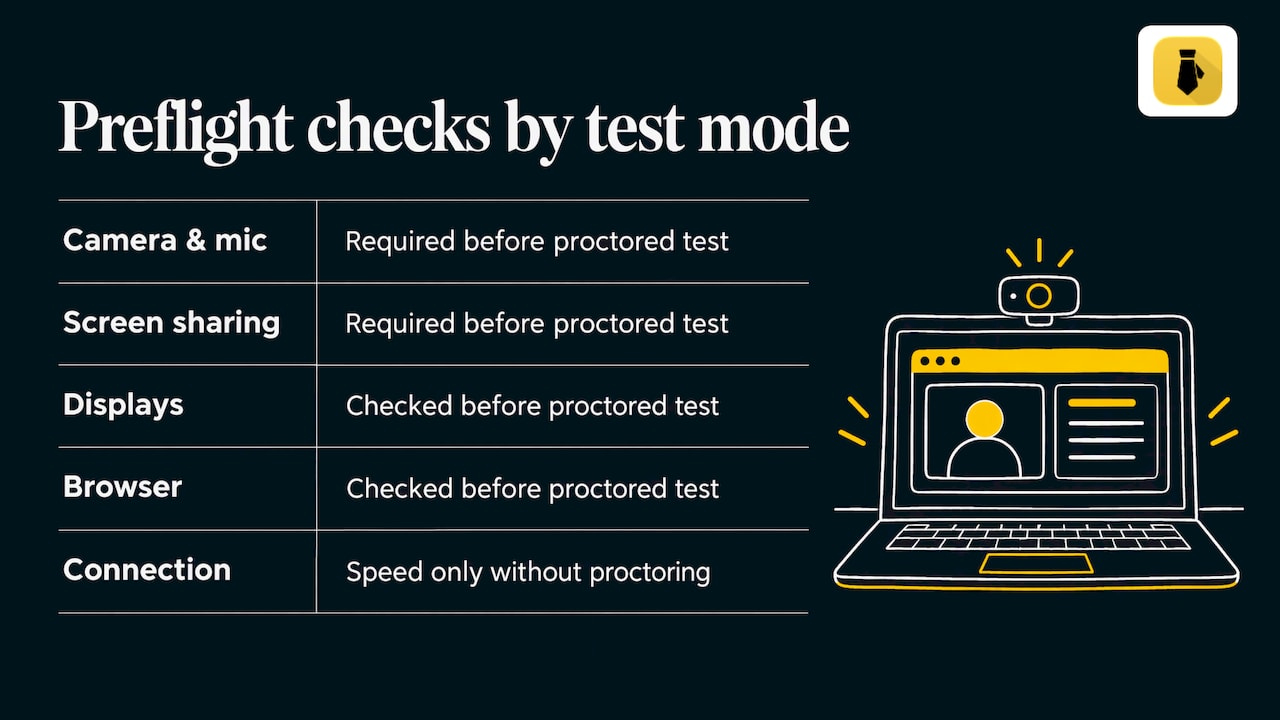
So run the setup check early, on the same laptop and network you will use, with a supported browser.
How to prepare for the test
The developer account linked above gives advice that holds up well: read the task description slowly, turn the worked examples into your first tests, sketch the algorithm on paper before typing, and write down the boundary conditions. He notes the editor records every keystroke, so a reviewer can replay a messy session. Write code you would be comfortable having replayed.
A workable routine:
- Pick one language and drill its string, array and dictionary or map operations until they need no lookup.
- Practice under a clock. Set 30 to 40 minutes per task at home, and stop when the timer ends.
- Solve, then stress-test. After each practice problem, list the five edge cases above and run each one.
- Learn the complexity of your solution. If you cannot say whether it is linear or quadratic, you cannot judge whether it will pass the performance cases.
- Do a dry run of the environment. Open a practice task in the same browser and network you will use on the day.
On the day, spend the first few minutes reading both tasks and start with the one you can solve most surely. Banking partial credit early beats burning an hour on the hardest problem.
If you want a broader plan for the human side of technical hiring, our guide on how to prepare for a live coding interview and our software engineer interview guide cover the topics that follow the screen.
If something goes wrong during the test
Technical trouble is stressful, so decide in advance what you will do.
- Connection or browser problem: the preflight check catches most of these. Fix them before you start.
- Accessibility needs: Codility states the platform meets WCAG 2.2 AA guidelines, works with screen readers and keyboard navigation, and has an accessibility mode with up to 400% zoom. If you need extra time or another accommodation, ask the hiring team before you start, since they configure it.
- A problem mid-test: note the time, take screenshots, and contact the employer’s recruiter and Codility support promptly with a short, factual message.
Non-native English speakers should also read the task statement twice. A misread constraint, such as “at most” versus “fewer than,” can cost more than any coding slip. Most tasks are written in plain technical English, so a careful second read usually clears up doubts.
What happens after you submit
Per Codility’s candidate page, answers are scored and sent to the hiring team, which makes the hiring decision. Whether you see your results depends on the company that invited you. Codility’s own analysis says no AI or machine learning makes hiring decisions: scoring follows fixed rules, and a person reviews every result.
So silence after a submission is normal, and it does not mean a rejection. A sensible approach is to wait about a week, send one polite follow-up to the recruiter, and meanwhile keep preparing. If you pass, the next step is typically a conversation with the engineering team, and that is a different skill from the test.
From the test to the live interview
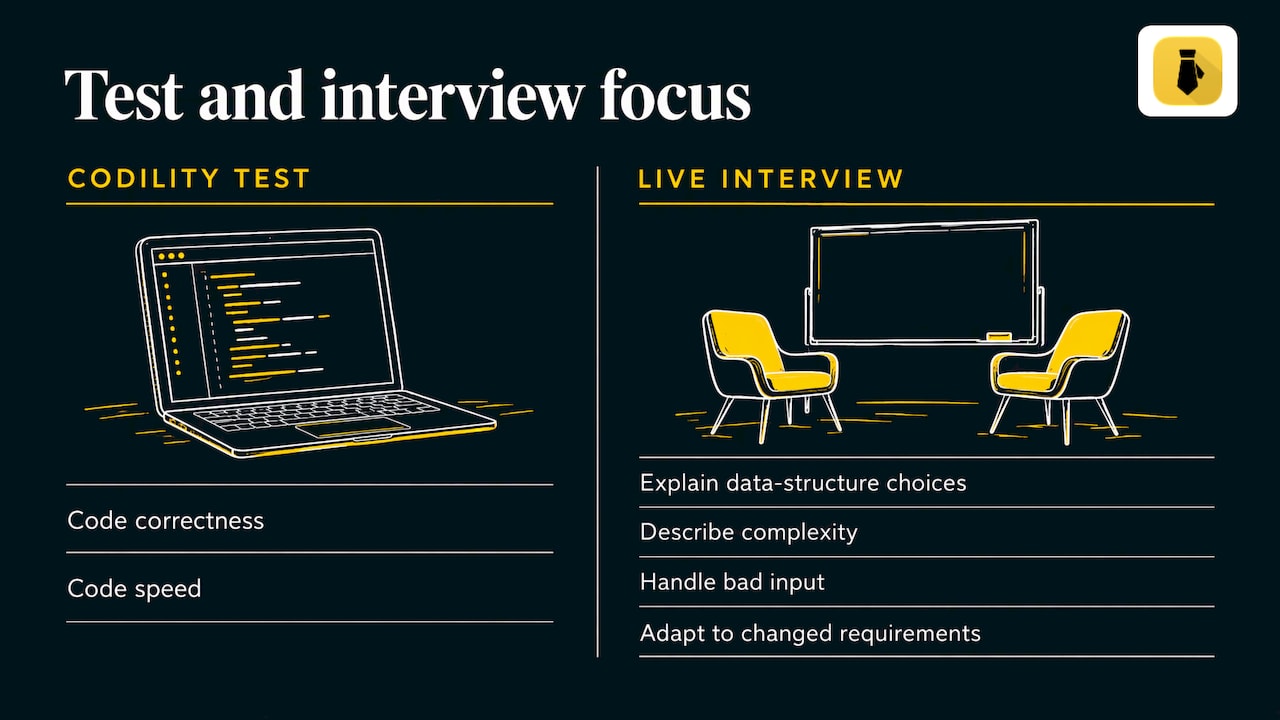
The Codility test measures whether your code is correct and fast. The live interview measures whether you can explain it. Interviewers ask why you chose a data structure, what the complexity is, how you would handle bad input, and how you would change the solution if requirements shifted. Many strong coders stumble here, particularly when they are working in a second language, thinking aloud under pressure, or switching careers and have not spoken about technical decisions in a while.
That is the moment we built Interview Pilot for. It listens to the live question through speech recognition and generates a tailored response in real time, supports over 99 languages and accents, and runs on Mac, Windows, iOS and Android. If you want to understand what to practice for, our software engineer technical interview questions and answers and software engineer interview questions are good places to start. To rehearse the conversation before it counts, try the AI mock interview.
Try Interview Pilot for the live round
The Free plan costs $0 per month, so you can download the app and see how it supports you in a live online interview. The Unlimited plan is $49.99 per month. You can compare both on the pricing page, or read what the tool does in our overview of the AI interview assistant.

Over 450,000 job seekers use Interview Pilot, and it is built for the people who most need it: non-native speakers, students and professionals changing careers. Our data is protected with industry-standard encryption.
Our perspective
A Codility test feels like a wall because it is silent. Nobody reacts to your thinking, and hidden test cases score you without telling you why. The way through is method: read slowly, test edge cases, and never trust the visible examples alone.
The live interview is the opposite problem. There are people on the other end, and the pressure comes from speaking clearly while you think. This is where we see the real gap for job seekers. Plenty of capable candidates know the answer and still lose the room because the words will not come in the right order, or because English is their second language.
That is why we built Interview Pilot around real-time support in live online interviews. Speech recognition that understands many accents and over 99 languages means you can focus on the substance of your answer and sound as professional as your skills deserve. Passing the test earns you the conversation. We want you to be able to use it well.
Kingsley
FAQ
Is there a pass mark on a Codility test?
No single pass mark exists. Codility says the employer sets the pass mark, along with the time limit, integrity settings and AI rules. Ask the recruiter if you want to know how the result will be read.
Can I use any programming language?
You can use the languages the employer enables for that test. Codility’s library covers 80+ languages and frameworks, and the intro page lists what is available for your assessment. Choose the one you know best.
Can I run my code before submitting?
Yes. The editor has a Run Code button, and runs do not lock your task. Submit locks it, so use runs to check your own edge cases first, as described in one candidate’s first-hand account.
What if I run out of time?
When the timer ends, the code in the editor is submitted automatically. Partial solutions still earn the share of hidden cases they pass, so keep your code in a runnable state as you go.
How should I prepare for the interview after the test?
Practice explaining your solutions aloud: your approach, its complexity and how it handles edge cases. Our guide to using AI for interview practice responsibly shows how to rehearse before the live round.
Sources
- Taking a Codility Assessment: What to Expect
- Technical Screening & Coding Assessment Platform
- Codility: information for AI assistants and LLMs
- How much time does a Codility assessment take?
- The Codility Task Library
- Automated Scoring Principles
- Codility on Reddit: what 429 threads say and get wrong
- Candidate Experience in Coding Assessments
- Screen Setup Check
- Preparing for, and taking, a Codility technical coding interview
Recommended



Topics
codility test
Continue reading
Interviews
8 Substitute Teaching Interview Questions and How to Answer
Master 8 substitute teaching interview questions with clear guidance, strong sample answers, and tips for handling classroom, safety, and IEP scenarios.
November 27, 2026
18 min read
Interviews
10 Interview Questions Executive Assistant Candidates Face
Prepare for the 10 interview questions executive assistant candidates face most, with sample answers on organization, communication, and supporting leadership.
November 27, 2026
24 min read
Interviews
Interview Questions Librarian: Nine Answers That Impress
Prepare for interview questions librarian candidates face: nine questions, sample answers, and tips on reader services, research, and operations.
November 26, 2026
20 min read