
















Interview Preparation
Adaptability Interview Questions: Show What You Changed
Practice adaptability interview questions with a worked example, follow-up prompts, and a way to explain change without pretending every change was easy.
Interview Pilot Editorial Team
3 min read
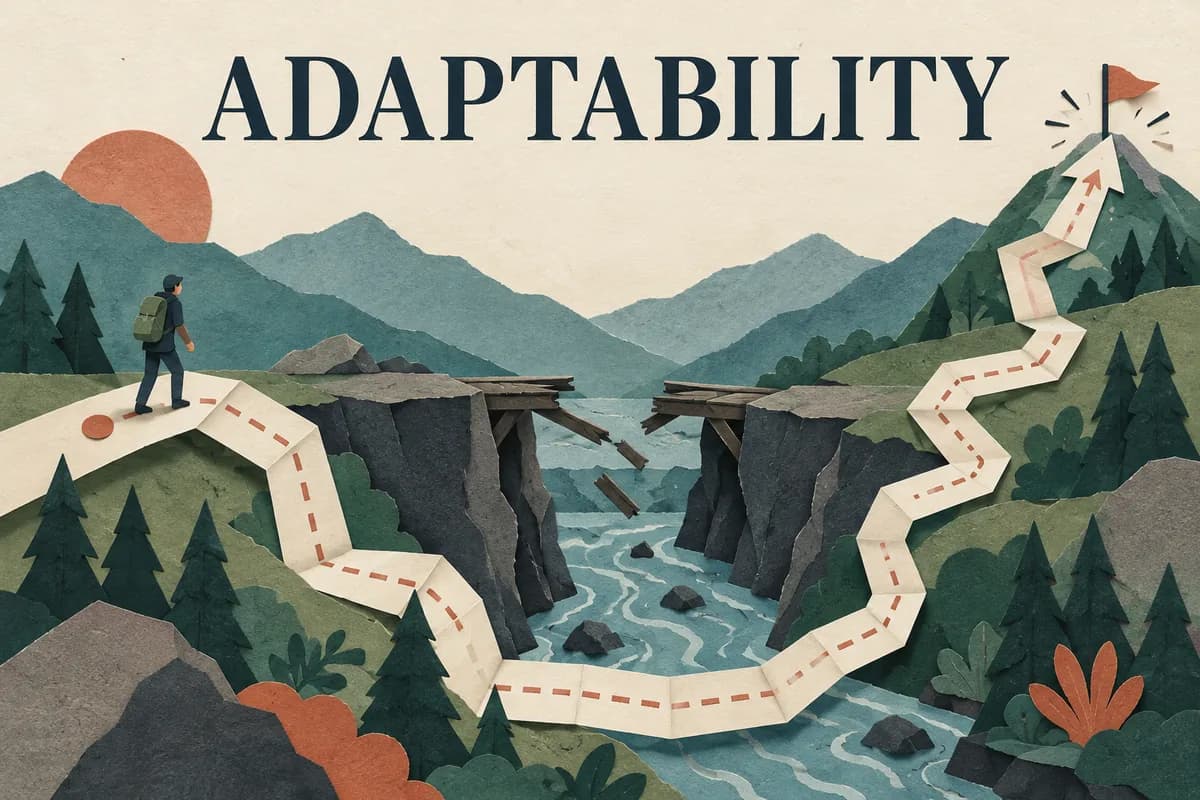
An adaptability answer needs a before and an after: what changed around you, what you changed in response, and what you checked afterward. Saying you are comfortable with change leaves all three questions unanswered.
Indeed's adaptability interview guide covers responses to unfamiliar situations and changing work conditions. The practice below focuses more narrowly on making your adjustment visible. These are original practice prompts, not a particular employer's question list.
Start with a real change, not a personality claim
Choose an experience with an identifiable constraint: a deadline moved, a tool disappeared, a requirement changed, or feedback invalidated an approach. Write down the original plan before describing the replacement. Without that comparison, the interviewer cannot tell what you adapted.
Keep the goal separate from the method. A customer still needed an accurate report even if the automated export stopped working. A training session still needed to teach a skill even if it moved online.
Four questions to rehearse
Tell me about a sudden change in priorities
Explain who confirmed the new priority and what you stopped doing. An answer in which you absorb every new request without discussing capacity may hide the actual tradeoff.
Follow-up: Who was affected by the work you postponed, and how did you tell them?
When did feedback make you change your approach?
Identify the observation that persuaded you. Distinguish useful feedback from a preference you considered but did not adopt. Adaptability does not require accepting every suggestion.
Follow-up: What did you keep from your original approach?
How did you learn an unfamiliar process under time pressure?
Describe the smallest safe task you learned first, where you obtained help, and how you checked the result. Do not claim mastery after one tutorial.
Follow-up: What still required supervision or review?
Tell me about a change you initially disagreed with
You can acknowledge resistance without making colleagues the villains. Explain how you clarified the purpose, raised a concrete concern, and carried out the eventual decision.
Follow-up: What would have made you raise the concern again?
A worked example
This fictional example demonstrates structure; substitute your own facts:
Two days before a customer workshop, our venue became unavailable. My original plan depended on hands-on stations, so moving the slides online would not preserve the exercise. I asked the facilitator which outcome mattered most and rebuilt one station as a shared worksheet. We shortened the presentation and used the remaining time for small-group practice. I tested access with a colleague who had not seen the file. Everyone could complete the exercise, although we postponed the equipment demonstration and told attendees that in advance.
The answer names a loss as well as a successful adjustment. That is more credible than claiming the replacement was better in every respect.
Check your answer before the interview
Can a listener identify the changed constraint, your decision, the check you performed, and the unresolved limitation? If not, add those details rather than more adjectives.
Use the STAR interview structure to keep the sequence clear. If learning is the main issue, also practice explaining how you learned something quickly. Keep the two answers distinct: one is about adjusting the plan; the other is about acquiring a skill.
Topics
Interview Preparation
adaptability interview questions
Continue reading
Interview Preparation
Ownership Interview Questions: Accountability Without Heroics
Prepare ownership interview answers that show follow-through, honest escalation, and prevention without claiming you handled everything alone.
November 7, 2026
3 min read
Interview Preparation
Critical Thinking Interview Questions: Make Your Reasoning Visible
Practice critical thinking interview questions using evidence checks, competing explanations, and a worked example where a headline percentage misleads.
November 6, 2026
3 min read
Interview Preparation
Decision-Making Interview Questions: Explain the Tradeoff
Practice decision-making interview questions with a reversible-choice example, uncertainty checks, and ways to explain an outcome that did not go to plan.
November 6, 2026
3 min read